
Reviewed · GYEONGBOKGUNG PALACE TOURS
Seoul City Half Day Tour-Gyeongbok Palace Guard Changing Ceremony
The Changing of the Guard at Gwanghwamun Gate is the star of this three-hour Seoul tour. Bright uniforms, drums, formal movements, and the grand palace gate give you a quick, memorable look at Korea’s royal traditions. You also visit Jogyesa Temple and see the Blue House area, so the morning covers old and modern Seoul in one sweep.
I like the efficient coach transport and the guides, who add context that is hard to pick up while exploring alone. Guides named Kelly, Emily, Ray, Sunny, Gabby, and others have been praised for clear explanations, useful photo advice, and warm help with questions. The main drawback is the final ginseng stop, which is a sales visit more than a museum. If you dislike shopping pitches, you may find it frustrating.
Key points before you book
- The palace ceremony is the highlight: Your guide aims to position the group near Gwanghwamun Gate for a clear view.
- Three hours covers several major sights: Jogyesa Temple, palace grounds, the Blue House area, and a cultural exhibition fit into one morning.
- You get hotel pickup: The tour begins with pickup in Seoul, then ends at a central drop-off rather than returning you to your hotel.
- The group may reach 40 people: A large coach keeps the price down but can make the palace walk less personal.
- Tuesday follows a different plan: Gyeongbokgung and its museums close on Tuesdays, when the route changes to other Seoul sights.
- The ginseng visit is commercial: Allow for a sales presentation at the end, not just a quiet museum visit.
Why the guard ceremony makes this tour worth considering
Seoul has plenty of palaces, temples, museums, and shopping streets. The challenge is fitting the best-known sights together without spending half the morning figuring out transport. This tour solves that problem with a coach, a local guide, and a simple route through central Seoul.
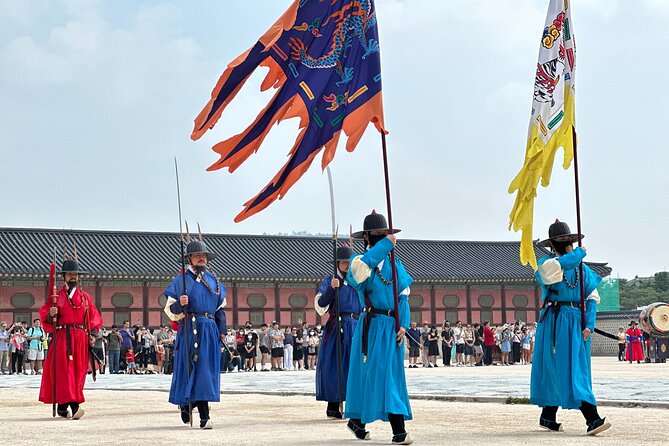
The ceremony takes place at Gwanghwamun Gate, the main entrance to Gyeongbokgung Palace. It is carefully staged and highly visual. The guards wear traditional dress, follow formal movements, and create the sort of spectacle that makes sense even if you know little about Korean history.
The timing matters. You are not simply dropped at the palace and left to wander. The guide leads you through the compound and gets you to the gate for the ceremony. One particularly useful detail is the guide’s choice of viewing position. Ray, for example, was praised for knowing where to stand for strong photos, while another guide placed the group in the front row.
The ceremony is also a good reason to make this your first Seoul outing. You get an immediate sense of the city’s royal past, then have the afternoon free to explore Bukchon, Insadong, Myeongdong, or another area on your own.
More Gyeongbokgung Palace Tours in Seoul:
- Seoul: Gyeongbok Palace, Bukchon Village, and Gwangjang Tour
★ 4.9 · 2,321 reviews - Best Seoul City Tour (Gyeongbokgung Palace,Insadong,Namsan Tower)
★ 5.0 · 1,647 reviews - Seoul City Sightseeing Tour Including Gyeongbokgung Palace, N Seoul Tower, and Namsangol Hanok Village
★ 5.0 · 1,423 reviews
Jogyesa Temple offers a calm first stop
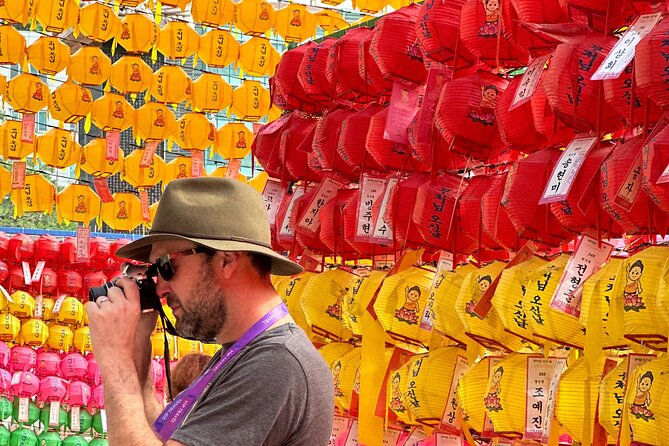
The morning begins at Jogyesa Temple, one of Korea’s leading Buddhist temples. It sits in central Seoul, but the tree-lined entrance gives the first stop a quieter feel than the streets outside.
You have about 40 minutes here. The guide points out the seven-story pagoda and takes you into the main temple building to see an important Buddha statue. That guided introduction is useful because the temple is not only a photo stop. It gives you a first look at Korean Buddhist practice and the role of temples in city life.
I like the contrast between Jogyesa and the palace. The temple is a working religious place, while Gyeongbokgung presents royal ceremony and court design. Seeing both in one morning gives the tour more range than a palace-only outing.
Do not expect a long period of quiet reflection. Forty minutes passes quickly, and the group must keep to the coach schedule. Still, the stop is well chosen. You see a major religious site without giving up the rest of the morning.
Cheongwadae Sarangchae connects culture and government
The route then moves to Cheongwadae Sarangchae, an exhibition hall with displays about Korea’s presidents, Korean cultural traditions, and UNESCO World Heritage Sites.
This stop helps explain modern Korea alongside the older landmarks. You are given time to look around rather than simply passing the building from the coach. The exact amount of time can vary with the group and the day, but the stated plan allows about 30 minutes for the museum portion of the outing.
The name can cause some confusion. Cheongwadae is the Korean name for the Blue House, the presidential residence. Cheongwadae Sarangchae is the nearby exhibition space. Your tour also passes by the Blue House itself, much as a Washington sightseeing route might pass the White House.
The stop is best treated as a short orientation to Korean public life and culture. It is not the main reason to book the tour, but it adds useful context before the royal palace visit.
Passing the Blue House adds a modern Seoul view
The Blue House, or Cheongwadae, served as the Korean presidential home. On this route, you pass by the site by coach rather than taking a full interior tour.
That distinction matters. If you want an in-depth visit to the presidential grounds, this is not the right product. The value here is convenience. You see an important modern landmark while moving between the exhibition hall and Gyeongbokgung, without adding another long stop to a short morning.
The coach is especially helpful in a city where central sights are close on a map but can still take time to connect. You avoid arranging a taxi between each stop, and the guide can point out what you are seeing as you go.
A few more Seoul trips to weigh up
- Small-Group Royal Palace and Seoul City Tour (hotel pick-up)
★ 5.0 · 1,474 reviews - Seoul: Dark Side of the City and Ghost Stories Walking Tour
★ 4.8 · 484 reviews - Seoul City Private Full-Day Tour Including Lunch
★ 5.0 · 469 reviews - Seoul: Guided City Wall Sunset Hike with Korean Dinner
★ 4.9 · 227 reviews
Gyeongbokgung is the morning’s main course
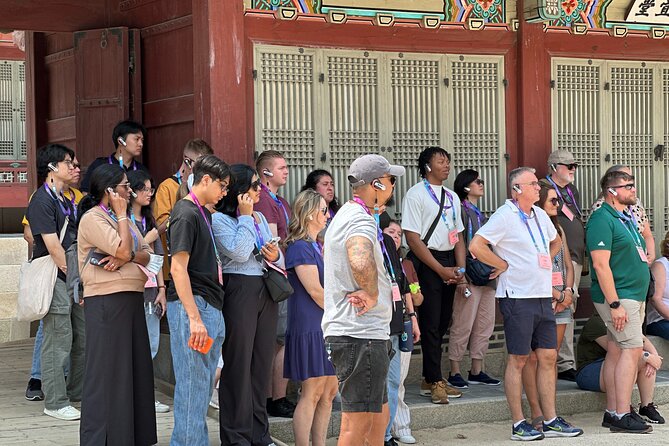
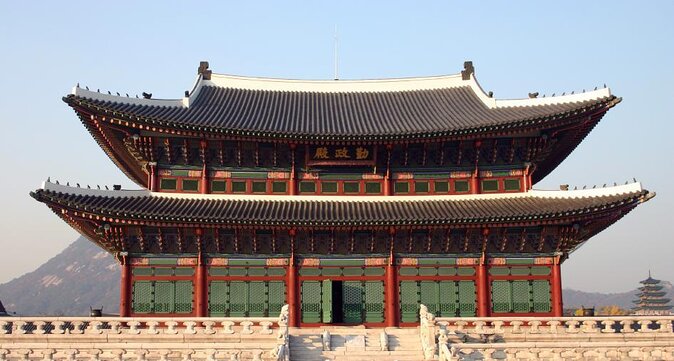
Gyeongbokgung Palace was built in 1394 and served as the primary royal residence during the Joseon Dynasty. It is the largest of Seoul’s Five Grand Palaces, and its broad courtyards, formal gates, and traditional buildings give you the clearest sense of the old royal city.
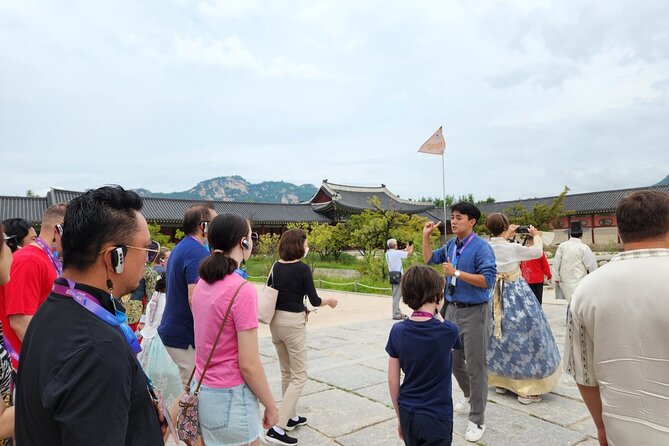
You spend about an hour at the palace. That includes a guided walk through the grounds and time for the guard-changing ceremony at Gwanghwamun Gate. The schedule is enough for a strong first look, but not enough to inspect every corner or museum at a slow pace.
The guide makes a real difference here. Palace compounds can look like a sequence of attractive buildings unless someone explains their purpose and place in Korean history. Guides such as Emily, Kelly, Henry, Crystal, and Hana have been praised for explaining the significance of the buildings and answering questions. That does not guarantee which guide you will receive, but it gives you a useful sense of the tour’s best feature: the human explanation.
Plan for outdoor walking. One visitor specifically advised bringing a hat in hot weather, and another found the summer heat difficult. A winter tour can be cold too. One outing took place during heavy snow, yet the guide still helped keep the visit moving. Wear shoes suitable for paved courtyards and bring protection from sun, rain, or cold.
The museum stop needs a careful reading
The supplied details refer to the National Folk Museum of Korea and also describe the National Palace Museum of Korea. The route information gives this portion about 30 minutes, with admission included when the palace and museum are open.
You should think of this as a brief cultural museum stop, not a full museum visit. Thirty minutes is enough to see selected displays and understand how Korean court life, customs, and national culture are presented. It is not enough for a detailed visit to every gallery.
This short stop works well for someone who wants a broad introduction. If museums are your main interest, plan to return independently with more time. The tour’s purpose is to give you a first layer of context before sending you back into Seoul for a longer afternoon visit.
Tuesdays change the palace plan
Gyeongbokgung Palace and the National Folk Museum close every Tuesday. The tour therefore uses an alternate route on that day.
The published Tuesday replacement includes Changdeok Palace and Bukchon Hanok Village. Other information also notes Deoksugung Palace, with the Seoul Museum of Art on its grounds, as an alternative. Since the supplied details describe more than one Tuesday arrangement, check the exact route for your date before booking.
This is important because the guard-changing ceremony is tied to the normal Gyeongbokgung visit. If that ceremony is the main reason you want the tour, avoid Tuesday unless the operator confirms that the replacement meets your expectations.
A Tuesday tour can still offer a good introduction to Seoul. Changdeok Palace and Bukchon provide a different look at royal architecture and traditional neighborhoods. You simply should not assume you will see the same palace ceremony.
The ginseng stop is the tour’s weak point
The final stop is listed as a ginseng museum and shopping visit at a ginseng center. In practice, you should expect a commercial presentation in a shop setting.
You may hear a short explanation of Korean ginseng and then be shown products for sale. Some people enjoy learning about the product or choose to buy something. Others dislike being placed in a room for a sales pitch, especially after the palace portion has already delivered the main cultural value.
This stop is not optional in the published schedule, so go in prepared. You can listen politely, decline to buy, and treat the 30 minutes as the cost of joining a low-priced coach tour. Still, if shopping presentations are a firm no for you, this is a serious reason to choose a different Seoul tour.
The sales stop also affects the value calculation. At $38 per person, the tour is inexpensive for hotel pickup, transport, a guide, palace admission, and several central sights. The ginseng visit is one way the operator can keep the price attractive, but it means the tour is not a pure sightseeing experience.
Transport, timing, and the end of the morning
The tour lasts about three hours and uses an air-conditioned coach. Hotel pickup is offered in Seoul, and the tour details indicate that the operator has sometimes arranged pickup from a nearby hotel or helped with a meeting point when a traveler was delayed.
The formal meeting information lists City Hall Station, while the route ends with a central drop-off. Details mention City Hall, Itaewon, or Myeongdong in different places, so confirm the exact end point for your booking. You should not expect to be returned to your hotel.
That central finish is useful. You can continue with lunch and an afternoon of independent sightseeing. One guide even helped point out lunch options around Insadong after the tour, although lunch itself is not included.
The maximum group size is 40. That is a fairly large group for palace grounds. The coach makes city transport easy, but you may spend time gathering people at each stop. The experience can feel more personal when attendance is low, and one small group was even able to adjust its drop-off point near its hotel.
Most people can take part, and the tour operates near public transportation. If you have mobility concerns, contact the operator before booking. One guide received special praise for helping a person whose wife had a disability, but the supplied information does not promise a fully accessible route.
Guide quality shapes the experience
The tour’s strongest personal element is the guide. Names repeatedly associated with warm, useful tours include Kelly, Emily, Ray, Sunny, Gabby, Yuna, Hana, Crystal, Jenny, Henry, and Nancy.
The best guides do more than recite dates. They explain why a temple matters, identify good spots for photographs, connect the palace to Korea’s past, and give practical suggestions for the rest of your stay. Sunny, for instance, was described as cheerful and helpful with restaurant advice, while Jenny made an effort to engage a tired group arriving early in its trip.
The listed guiding languages are English or Chinese. If you need one language in particular, confirm availability before paying. A strong guide can turn a fast tour into a useful introduction, while a large group and a less engaging presentation may make the pace feel hurried.
Is $38 good value?
At $38, I consider this a fair deal for a first morning in Seoul, especially if you value convenience. You receive hotel pickup, coach transport, a professional guide, admission to Gyeongbokgung and the guard ceremony, and access to the museum portion where scheduled.
You are also paying for saved planning time. Instead of working out a route between Jogyesa, the Blue House area, and the palace, you can follow a ready-made circuit. That matters on a first day, when jet lag and unfamiliar transport can eat up hours.
The value is weaker if you prefer slow exploration. You get roughly 40 minutes at the temple, an hour at the palace, and a short museum visit. The ginseng stop takes time away from the sights, and the group may be large.
I would compare this tour with a self-guided morning only if you are comfortable navigating Seoul and already know what you want to see. Public transport is a good option in the city, but this package offers a guide and a guaranteed structure for a modest price.
Who should book this Seoul morning tour?
I would choose it for a first visit, a short stay, or a morning when you want basic orientation before exploring alone. Families and older visitors may appreciate the coach and the limited number of major stops. It also suits anyone who wants the guard ceremony without having to plan its timing.
It is less suitable for a palace specialist, a serious museum visitor, or anyone who wants a relaxed photographic walk. It is also a poor match if you strongly dislike sales stops.
Book a non-Tuesday date if the guard ceremony is essential. Wear comfortable shoes, carry water and sun protection in warm weather, and leave room in your schedule after the final drop-off. Free cancellation is available up to 24 hours before the start time, but cancellations inside that window are not refunded. Poor weather or failure to meet the minimum group size may lead to a different date, another experience, or a full refund.
Should you book it?
Book this tour if you want to see Seoul’s key royal and cultural sights quickly, with transport and a guide handling the details. The palace and guard ceremony are strong reasons to go, and a good guide can make the history stick.
Skip it if the ginseng shop would ruin your morning or if you want to set your own pace. For most first-time visitors, though, $38 buys a useful introduction to Seoul, provided you accept the fast schedule, possible group of 40, and commercial stop at the end.
FAQ
How long does the Seoul half-day tour last?
The experience lasts approximately three hours and takes place in the morning.
Does the tour offer hotel pickup?
Yes. Hotel pickup in Seoul is included. The tour ends at a central drop-off rather than returning you to your hotel.
Which languages are available?
The listed guide languages are English and Chinese. Confirm your preferred language when booking.
Will I see the Changing of the Guard ceremony?
The regular route includes the ceremony at Gwanghwamun Gate at Gyeongbokgung Palace. The palace and ceremony are not available on Tuesdays because Gyeongbokgung is closed.
What happens on Tuesdays?
The Tuesday route uses alternative sights because Gyeongbokgung Palace and the National Folk Museum are closed. The supplied details list Changdeok Palace and Bukchon Hanok Village, and also mention Deoksugung Palace and the Seoul Museum of Art as possible alternatives. Confirm the exact route for your date.
Is lunch included?
No. Lunch is not included. The tour finishes at a central location, leaving you free to find lunch and continue sightseeing on your own.
Just added around Seoul
- Gyeongbokgung palace,seoul with gigibebe hanbok rental★ 4.5 · 12 reviews
- Private tour guide service in Seoul, Korea★ 5.0 · 6 reviews
- Alpaca, Nami, Petite Fr, Italian Village, Garden of Morning Calm★ 3.5 · 5 reviews
- Gyeongju UNESCO Sites Tour by KTX train; The Museum Without walls★ 4.5 · 11 reviews
- Private day trip to Korean Folk Village & Dae Jang Geum Park★ 5.0 · 7 reviews
- Private tour Lotte World,Tower,Aquarium(All Tickets are included)★ 5.0 · 12 reviews
- Full Day Private Seoul Tour for foodies★ 5.0 · 3 reviews
- Seoul Private Custom Walking Tour with A Guide (Private Tour)★ 4.5 · 28 reviews
Gyeongbokgung Palace Tours, compared.
Gyeongbok Palace, Bukchon Village, and Gwangjang Tour
Read our review →
Best Seoul City Tour (Gyeongbokgung Palace,Insadong,Namsan Tower)
Read our review →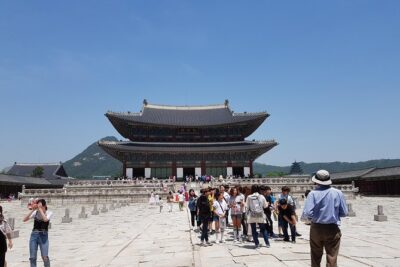
Seoul City Sightseeing Tour Including Gyeongbokgung Palace, N Seoul Tower, and Namsangol Hanok Village
Read our review →Gyeongbok Palace, Bukchon Village, and Gwangjang Tour
Read our review →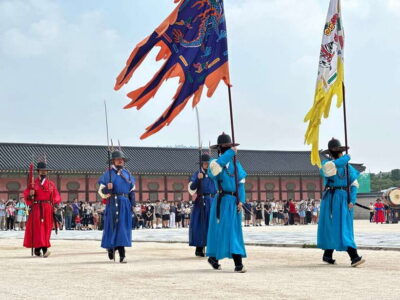
Seoul Highlights: Gyeongbok Palace, Insadong & N Seoul Tower
Read our review →
Hanbok Photoshoot and History Tour at Gyeongbokgung Palace
Read our review →Browse the lists this tour appears in