
Reviewed · CITY TOURS
Small-Group Royal Palace and Seoul City Tour (hotel pick-up)
Seoul’s royal past comes into focus on this full-day outing, which links two major Joseon palaces with a Buddhist temple, folk museum, old market, and traditional shopping street. You also get a look at the Blue House and, when conditions allow, the colorful guard-changing ceremony at Gwanghwamun Gate.
I like the small-group format, capped at 16 people, and the convenience of hotel pickup in central Seoul. I also like the range of stops: this is not just a palace tour, but a useful first look at religion, court life, shopping, food, and modern government. The tradeoff is a long day with road time, and the 30-minute ginseng-center stop may feel more commercial than cultural.
At a glance
- Two royal palaces in one day: Visit Gyeongbokgung, the main Joseon palace, and UNESCO-listed Changdeokgung.
- A strong first-day introduction: Combine Jogyesa Temple, the Blue House, palace grounds, Insadong, and Namdaemun Market.
- Guides who bring the past to life: Young, BK, Sookee, Lua, Joey, Yeoni, and others are assigned depending on the departure.
- Small group, not a giant coach: The maximum group size is 16, with a driver-guide setup and bottled water.
- Lunch is now independent: You have free time in Insadong to choose your own meal, rather than receiving an included lunch.
- Day-of-week planning matters: Monday and Tuesday closures change the route, with Bukchon Hanok Village used as an alternative.
Why this Seoul tour works for first-time visitors
At $56.44 per person, this is priced as an efficient sightseeing day rather than a private luxury tour. The fee covers central Seoul hotel pickup, an English-speaking local guide, transport, bottled water, and entrance fees for the palaces and museum. You finish near City Hall or Myeongdong rather than returning to your hotel, so the tour can also function as a convenient way to reach the center for an evening meal.
The main value comes from the number of places covered without making you organize Seoul’s complicated geography yourself. Jogyesa and the royal palaces are in or near Jongno, while Namdaemun is farther south. With traffic, those transfers take time, but the vehicle saves you from figuring out several subway connections during one packed day.
The tour has earned a 4.9 rating from 1,474 ratings, with 98 percent recommending it. The most consistent praise goes to the guides, especially Young and BK, for clear explanations, humor, patience, and help with photographs. Sookee is also praised for telling engaging stories about court intrigue and the Joseon kings, while Lua is noted for a friendly, thoughtful approach and help with translation during shopping.
You should still keep expectations sensible. Guide quality can vary by departure, and one experience described a guide who focused too heavily on palace drama while offering less wider context about Korea. Most of the strong feedback points in the other direction, but the tour is best understood as a broad introduction, not a specialist history seminar.
A few more Seoul trips to weigh up
- Best Seoul City Tour (Gyeongbokgung Palace,Insadong,Namsan Tower)
★ 5.0 · 1,647 reviews - Seoul City Sightseeing Tour Including Gyeongbokgung Palace, N Seoul Tower, and Namsangol Hanok Village
★ 5.0 · 1,423 reviews - Seoul: Dark Side of the City and Ghost Stories Walking Tour
★ 4.8 · 484 reviews
Jogyesa Temple and the calm at the start
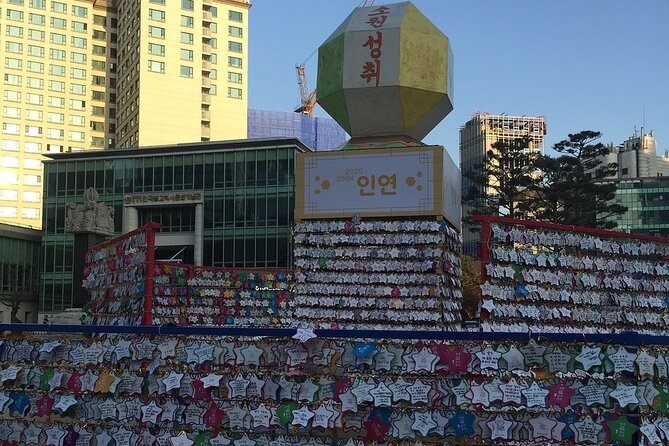
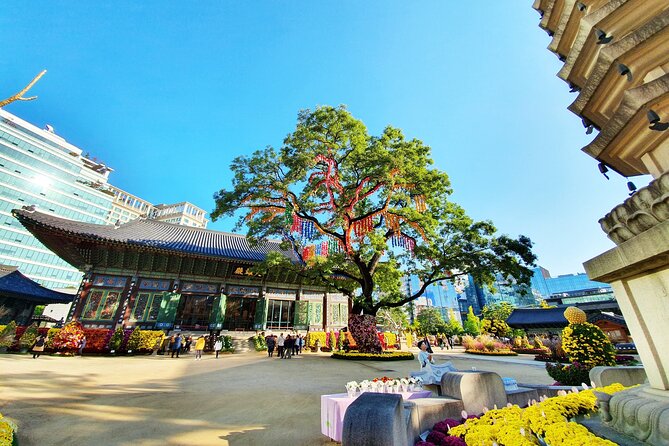
The morning begins at Jogyesa Temple, a Zen Buddhist center set beside busy Jongno streets. That contrast is part of its appeal. You leave traffic and commercial streets behind for a quiet temple courtyard decorated with bright colors and large golden Buddha statues.
You receive about 30 minutes here, enough to look around and hear why this urban temple matters in Korean Buddhism. It is a compact stop, so do not expect an extended temple visit or a long period for private reflection. Its real purpose is to set a cultural tone before the palace portion of the day.
For me, this is a smart opening stop. It shows that Seoul’s past is not confined to royal gates and museum displays. The city’s religious life remains part of the everyday setting, even when modern streets press right up against it.
Gwanghwamun Gate and the royal guard ceremony
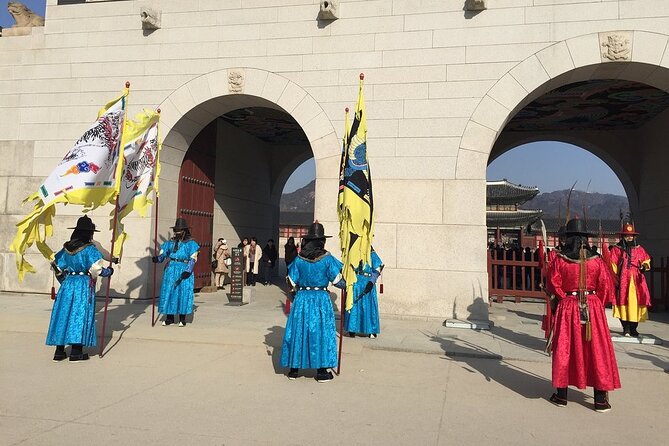
At Gwanghwamun Gate, you may watch the changing of the royal guards, a short ceremonial display that gives the palace entrance a sense of occasion. The stop lasts around 20 minutes, so keep your camera ready and listen for your guide’s instructions about where to stand.
The ceremony can be canceled in poor weather. It is also worth remembering that this is a modern presentation of royal tradition, not an unchanged Joseon-era event. Even so, the uniforms, movement, color, and gate make it one of the day’s most photogenic moments.
The timing is important. The tour is arranged to reach Gwanghwamun for the ceremony, but conditions can interfere. If the display is canceled, the gate and palace entrance still provide a useful introduction to Gyeongbokgung.
Gyeongbokgung Palace and Joseon court life
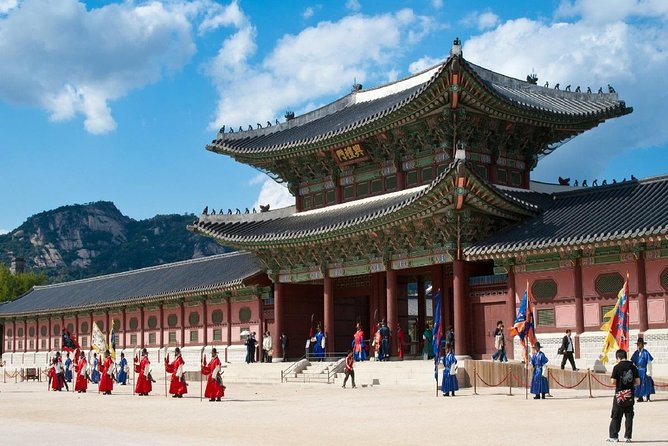
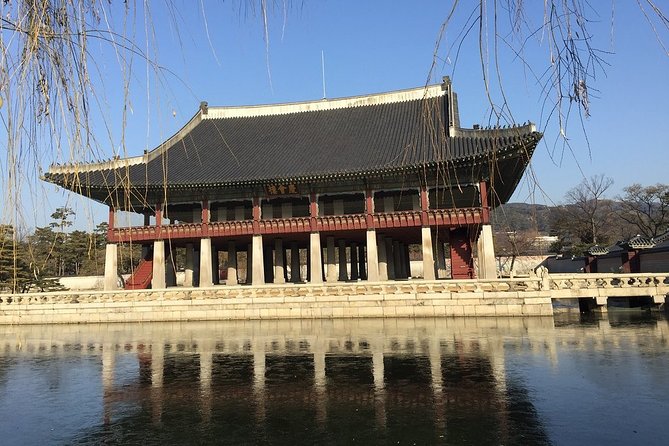
Gyeongbokgung was the main palace of the Joseon dynasty, and it is the largest royal setting on the tour. You spend about an hour here, walking among formal courtyards and traditional buildings while your guide explains the dynasty, royal officials, and palace routines.
The best part of a guided visit is the context. Without help, it is easy to see a succession of handsome roofs and open courtyards without understanding how the spaces were used. Guides such as Young and BK are praised for explaining the political and personal stories behind the buildings, including the dramas of royal succession and court life.
Do not expect to cover every corner of the grounds in an hour. Gyeongbokgung is extensive, and the schedule gives you the key areas rather than unlimited wandering. If you want slow photography, detailed architecture study, or time in every hall, you may prefer a separate palace visit.
The palace is closed on Tuesdays. On that day, the schedule shifts to Changdeokgung, including its Secret Garden, with Bukchon Hanok Village added in the afternoon. That replacement is not a poor consolation. Bukchon offers a different view of Seoul through traditional hanok houses and residential lanes, though the experience changes from palace architecture to neighborhood streets.
Same country, a completely different kind of day:
- Best DMZ Tour Korea from Seoul (Red Suspension Bridge Optional)
★ 5.0 · 41,422 reviews - DMZ Tour: 3rd Tunnel, Option(Suspension Bridge, Boat) from Seoul
★ 5.0 · 21,373 reviews - DMZ tour south Korea from Seoul (NK experience hall, defector)
★ 5.0 · 20,599 reviews - Seoul: DMZ Tour with Optional Suspension Bridge
★ 4.8 · 5,277 reviews
The National Folk Museum in a short visit
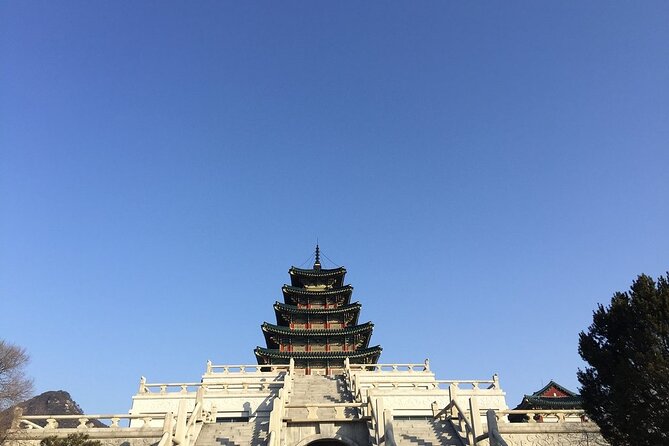
Within the Gyeongbokgung compound, the National Folk Museum of Korea adds a useful change of pace. Its displays focus on daily life, showing how people lived from earlier periods into modern times. You may see material related to aristocratic households as well as ordinary routines.
The scheduled visit is about 20 minutes. That is enough for an introduction, but it is the part of the day most likely to feel rushed if you enjoy museums. One person specifically wished for more time here, and I understand why. The museum can give you more insight into food, clothing, homes, and customs than a palace courtyard alone.
Treat this as a selected museum stop rather than a full museum visit. If the exhibits interest you, note the name and return independently if your Seoul schedule allows. On Tuesdays, both Gyeongbokgung and the National Folk Museum are closed, so they are replaced by the alternate route.
The Blue House and a modern political landmark
The Blue House, or Cheong Wa Dae, is viewed from outside. It was built on the site of a Joseon royal garden and served as the official presidential residence until May 2022. Your guide points out the traditional Korean design and the setting beneath Mt. Bukak.
This is a brief visual stop, not an interior tour. Its value lies in the connection between royal Seoul and the modern Republic of Korea. The same northern part of the city contains palace grounds, old mountain views, government buildings, and neighborhoods shaped by centuries of political change.
Since the stop is viewed from outside, keep your expectations modest. It works best as part of the larger story rather than as a destination that fills a major portion of the day.
The ginseng center: useful context, commercial feel
Before lunch, the vehicle stops at the Cheongha Korea Ginseng Museum, described as a government-approved Korean Ginseng Center. You can taste ginseng tea and learn about Korean ginseng products. The stop lasts about 30 minutes.
This is the most divisive part of the route in practical terms. Some people enjoy learning about ginseng and having a chance to taste it. Others feel the stop is unnecessary, especially when time at the Folk Museum is already short. I would treat it as an educational shopping stop, not as one of Seoul’s essential sights.
You do not need to buy anything to benefit from the visit. Listen to the explanation, try the tea if you wish, and keep your spending separate from the tour price. If you prefer an entirely historic or neighborhood-focused day, this is the clearest compromise in the schedule.
Insadong, lunch, and time to wander
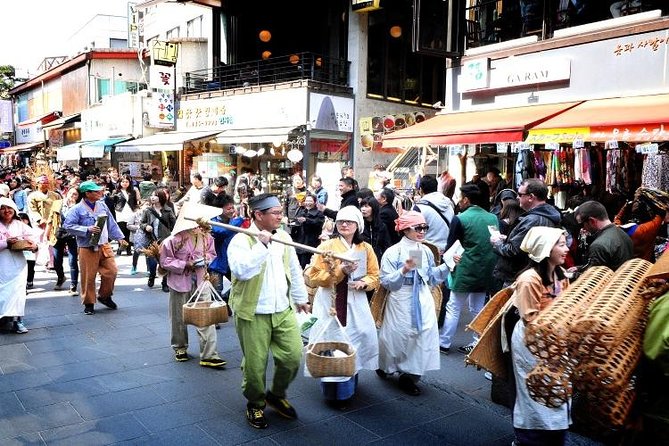
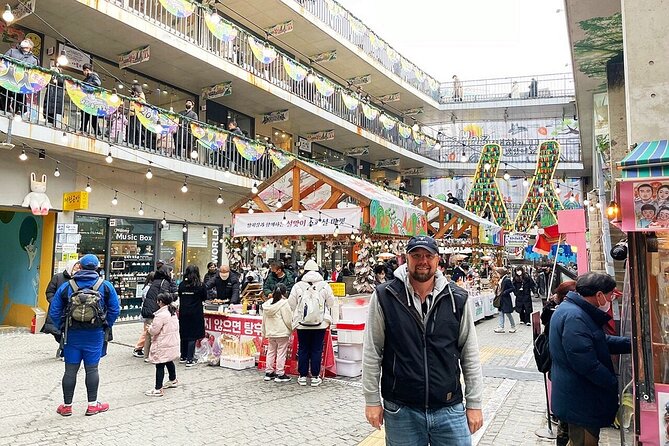
Insadong is the tour’s main break for traditional culture and personal exploration. The area is associated with antique shops, crafts, tea houses, galleries, and goods linked to Korean tradition. You have about 1 hour and 20 minutes here, which is generous compared with several other stops.
Lunch is no longer included for departures beginning September 1, 2024. Instead, you have free time to choose your own meal in Insadong. This change is useful if your group has different tastes or dietary needs, but you should budget for lunch and make decisions quickly because shopping time competes with eating time.
One guide, Yeoni, arranged an optional lunch for people who did not want to search on their own. That kind of help may be available depending on the guide, but it is not part of the stated inclusion, so do not count on an included meal or a fixed restaurant.
I like having this unstructured stretch in the middle of a very organized day. You can browse traditional goods, enter a Korean tea house, or simply sit down and eat. If Insadong interests you, you may want to return on another day. An hour and 20 minutes gives you a taste, not enough time to explore every side street and shop.
Changdeokgung Palace and the pleasure of a smaller scale
Changdeokgung was built in 1405 as the second royal villa after Gyeongbokgung. It later served as the principal palace for several Joseon kings and is regarded as the best-preserved of Seoul’s royal palaces. Its UNESCO World Heritage status reflects its cultural importance and the way its buildings relate to the surrounding setting.
The tour allows about an hour. Guides explain the palace’s role and help you notice differences from Gyeongbokgung. Gyeongbokgung feels more formal and expansive, while Changdeokgung is often appreciated for a more intimate relationship between buildings and gardens.
Some departures may include the Secret Garden when the schedule changes for Tuesday. The provided tour details specifically mention Changdeokgung including the Secret Garden on Tuesday, while the regular stop lists about an hour at the palace. Ask your guide about the exact Tuesday route if the garden is important to you.
Changdeokgung is closed on Mondays. The Monday replacement is Bukchon Hanok Village, which gives you traditional homes and urban streets instead of palace interiors. That alternative has been especially well received as a worthwhile addition, but it does require more walking on neighborhood lanes.
Namdaemun Gate and market energy
The final stop is Namdaemun Gate, also called Soongryemun. Built in 1396 during King Taejo’s reign and reconstructed in 1447 under King Sejong, it was a major gate in Seoul’s former fortress. It is recognized as Korea’s most important National Treasure.
The scheduled stop is around 30 minutes, including time at Namdaemun Market. That is enough to see the gate, get a feel for the market, and perhaps make a quick purchase. It is not enough for a careful market crawl, so focus on the atmosphere and save any serious shopping for a separate visit.
Namdaemun works well at the end because it shifts the day from royal ceremony to everyday commerce. You finish with stalls, traditional goods, and the practical side of Seoul rather than another formal monument.
Drop-off is at City Hall or Myeongdong, not at your hotel. This is handy if you plan to continue sightseeing or want dinner in central Seoul. It is less convenient if you are tired and staying outside the central pickup area.
Transport, group size, and the pace of the day
The tour begins around 9 a.m. and lasts about eight hours. Pickup is offered from hotels in central Seoul, with the exact meeting time adjusted by location. The vehicle is described as comfortable, and bottled water is included.
A maximum of 16 people keeps the group small enough for questions and easier movement through palace grounds. Some departures can be much smaller. One group had only three people, creating a more personal day, though you should book for the stated maximum rather than expect a private tour.
Traffic is the unavoidable weakness. Seoul roads can slow the vehicle, and one account described a fair amount of transfer time. The driver-guide arrangement helps keep the day coordinated, but the tour cannot control congestion. Wear comfortable shoes and expect a moderate level of walking, standing, and time outdoors.
Winter requires proper clothing. Sookee was praised for warning people to prepare for the cold, a useful reminder because palace courtyards can feel exposed. Summer and rainy conditions can also affect comfort and the guard ceremony, so check the forecast and dress for a full day outside.
How the guides shape the experience
The assigned English-speaking guide makes a major difference here. Young is repeatedly praised for history, humor, photography help, and keeping the day moving without making it feel frantic. BK is noted for explaining the past clearly and adjusting the content for families with young teens.
Sookee brings stories about royal intrigue, Joseon rulers, and modern Korean history. Lua is described as friendly, accommodating, and willing to help with translation during shopping. Joey is praised for being informative and helpful, while Yeoni added value by helping organize an optional lunch during free time.
That range tells you what to expect: the route is fixed, but the tone and depth can vary. If you care most about history, tell your guide early. If you want shopping or food advice, ask during Insadong and Namdaemun rather than waiting until the last few minutes.
Who should book this tour
I would choose this tour if you have one full day in Seoul and want the main historic sights explained in English. It suits first-time visitors, families, couples, and people who prefer a vehicle and guide over managing several subway journeys.
It is also a good fit if you want a mixture of planned instruction and personal time. Insadong provides the main break, while the palace and museum stops give you a clear framework for understanding Seoul’s past.
I would look elsewhere if you want long, quiet visits at museums, extensive palace photography, or a food-focused itinerary. The ginseng center may not appeal to everyone, and the day includes road transfers. Independent visitors who are comfortable with Seoul’s public transport could spend more time at fewer places for less money.
Should you book it?
Book it if coverage and convenience matter most. For $56.44, you receive transport, central hotel pickup, a guide, water, and palace and museum admission, which is solid value for an eight-hour introduction.
Check the day of the week before paying. Monday replaces Changdeokgung with Bukchon Hanok Village, while Tuesday replaces Gyeongbokgung and the Folk Museum with Changdeokgung, including the Secret Garden, followed by Bukchon. Choose the regular route for two palaces, or choose Monday or Tuesday if Bukchon is high on your list.
The tour can be canceled for a full refund up to 24 hours before the start time. If you want a well-paced overview with strong historical storytelling, this is an easy choice. Just bring lunch money, comfortable shoes, and enough flexibility for Seoul traffic and weather.
FAQ
How long does the tour last?
The tour lasts approximately eight hours and begins at about 9 a.m.
What is the price?
The listed price is $56.44 per person.
Is hotel pickup included?
Yes. Pickup is included from hotels in central Seoul, with the meeting time adjusted according to the hotel location.
Is hotel drop-off included?
No. The tour ends at City Hall or Myeongdong rather than returning you to your hotel.
What entrance fees are included?
Entrance fees for the included attractions, including Gyeongbokgung Palace, Changdeokgung Palace, and the National Folk Museum when open, are included.
Is lunch included?
No. Starting September 1, 2024, lunch is not included. You have free time in Insadong to choose and pay for your own meal.
What happens if Changdeokgung is closed?
Changdeokgung is closed on Mondays. The tour visits Bukchon Hanok Village instead.
What happens on Tuesdays?
Gyeongbokgung Palace and the National Folk Museum are closed on Tuesdays. The route changes to Changdeokgung, including the Secret Garden, followed by Bukchon Hanok Village in the afternoon.
Can the guard-changing ceremony be canceled?
Yes. The ceremony at Gwanghwamun Gate may be canceled because of bad weather.
How large is the group?
The tour operates with a maximum of 16 people and proceeds with at least two participants.
Just added around Seoul
- Gyeongbokgung palace,seoul with gigibebe hanbok rental★ 4.5 · 12 reviews
- Private tour guide service in Seoul, Korea★ 5.0 · 6 reviews
- Alpaca, Nami, Petite Fr, Italian Village, Garden of Morning Calm★ 3.5 · 5 reviews
- Gyeongju UNESCO Sites Tour by KTX train; The Museum Without walls★ 4.5 · 11 reviews
- Private day trip to Korean Folk Village & Dae Jang Geum Park★ 5.0 · 7 reviews
- Private tour Lotte World,Tower,Aquarium(All Tickets are included)★ 5.0 · 12 reviews
- Full Day Private Seoul Tour for foodies★ 5.0 · 3 reviews
- Seoul Private Custom Walking Tour with A Guide (Private Tour)★ 4.5 · 28 reviews
City Tours, compared.
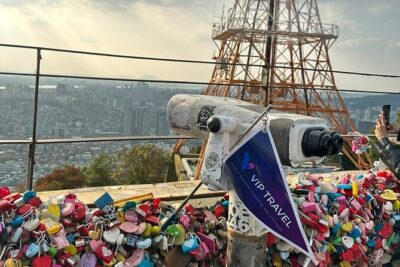
Best Seoul City Tour (Gyeongbokgung Palace,Insadong,Namsan Tower)
Read our review →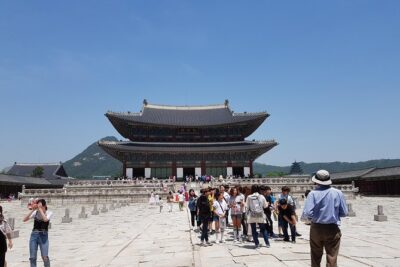
Seoul City Sightseeing Tour Including Gyeongbokgung Palace, N Seoul Tower, and Namsangol Hanok Village
Read our review →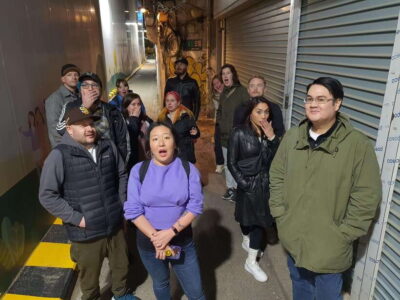
Dark Side of the City and Ghost Stories Walking Tour
Read our review →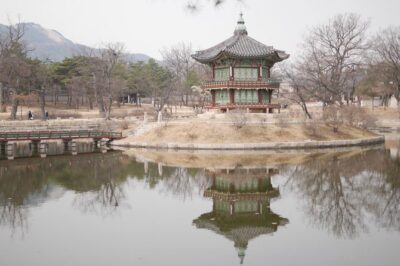
Seoul City Private Full-Day Tour Including Lunch
Read our review →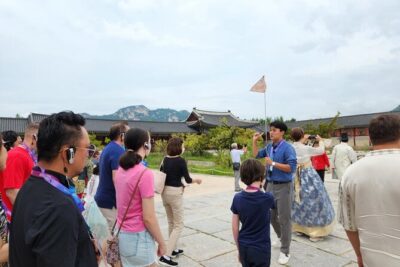
Seoul City Half Day Tour-Gyeongbok Palace Guard Changing Ceremony
Read our review →
Guided City Wall Sunset Hike with Korean Dinner
Read our review →
Browse the lists this tour appears in