
Reviewed · COOKING CLASSES
Local Home Korean Cooking Class & Market Adventure in Seoul
The best part of this Seoul experience is the change of setting: you begin at Mangwon Market, learning what Korean people actually buy and eat, then carry that knowledge into a local home kitchen. Host Sarah or Junghee guides the group through the market before leading a hands-on class and a full Hanjeongsik meal.
I like the market stop because it gives meaning to ingredients you may otherwise pass without noticing. I also like the practical teaching style, with simple cooking tips, Korean phrases, recipes to take home, and plenty of help at the stove. The main consideration is time: three and a half hours is a substantial part of your day, and a small home kitchen may feel close if you prefer a large, polished cooking school.
Key things to know before you book
- Mangwon Market comes first: Learn about Korean produce, herbs, spices, snacks, and street foods before cooking.
- Four dishes are prepared: The menu may include favorites such as bibimbap or dakgalbi.
- The class is fully hands-on: You do more than watch a chef demonstrate.
- The final meal is generous: Your dishes arrive with more than 10 homemade side dishes, dessert, and makgeolli.
- The group is capped at 10 people: A smaller class allows the host to answer questions and correct techniques.
- The price reflects a full afternoon: At $91 per person, you are paying for the market visit, tastings, class, recipes, and meal rather than a short demonstration.
Starting at Mangwon Station and meeting your host
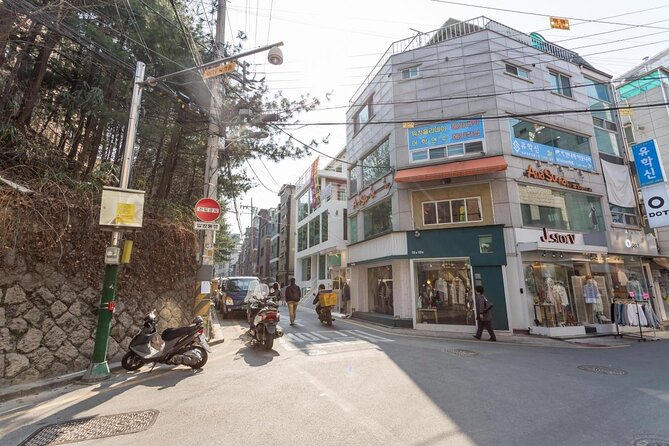
The experience begins at Mangwon Station Entrance 2, with the meeting point listed at 377-20 Mangwon-dong, Mapo-gu, Seoul. This is useful for a first visit to Seoul because you do not need to find a private residence on your own. You meet the host near public transportation, then begin the walk together.
The activity lasts about three hours and 30 minutes and ends back at the meeting point. Plan your day around that full block of time. I would avoid booking a tight museum entry, show, or restaurant reservation immediately afterward, since the cooking and meal portion can be sociable and may not finish at exactly the advertised minute.
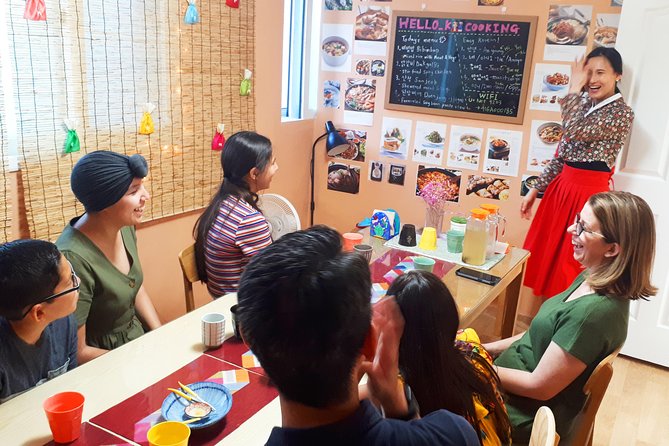
The class accepts a maximum of 10 people. That limit matters here. In a cooking class, a large crowd can leave you waiting for a cutting board or trying to see over someone’s shoulder. A group of this size gives the host room to explain a technique, answer a question, or help you adjust a dish.
The tone is friendly and informal. Sarah is described as lively and funny, while Junghee is praised for making the class feel like a cooking lesson mixed with a comedy show. If you like structured tours with a quiet, formal guide, this may feel energetic. If you enjoy conversation and a host who talks with the group, it should suit you well.
A few more Seoul trips to weigh up
- Master Korean traditional cooking with a Kimchi chef
★ 5.0 · 385 reviews - Seoul: Korean Cooking Class at a Local Home and Market Tour
★ 5.0 · 348 reviews - Seoul: Korean Cooking at Seoul Cooking Club!
★ 5.0 · 311 reviews
Walking through Mangwon Market
The market portion is not filler before the cooking begins. It is where you learn how Korean food is built. Your host points out local ingredients, explains typical herbs and spices, and introduces the foods sold around the market. You also get a chance to sample street snacks.
This is especially helpful if Korean food is new to you. Menus often use Korean names without much explanation, and a market gives you a visual guide to the ingredients behind those names. You might learn the difference between items that look similar, see how spring onions are used instead of chives, or pick up words that help you shop and order during the rest of your Seoul stay.
The tasting element adds a pleasant bit of discovery. Specific snacks mentioned by the host include kwabaeggi, a twisted Korean doughnut, and Korean market treats such as doughnuts and popsicles. The exact tasting selection can vary, so think of this as a chance to try what is available rather than a fixed snack menu.
I like the way this walk connects food to daily life. You are not simply told that an ingredient is common in Korea. You see it in the market, hear how it is used, and then may handle it again in the kitchen. That three-part link makes the information easier to remember.
The walk can also be a useful introduction to Mangwon. You see a local shopping area rather than only the major tourist sights of central Seoul. Still, the market is an active shopping place, not a quiet exhibit. Expect movement, food stalls, and a normal neighborhood pace. Wear comfortable shoes and keep your belongings secure as you walk.
The market visit includes street-food samples, but the main meal comes later. Do not fill up on snacks if you want to enjoy the final spread.
Cooking four Korean dishes in a local home
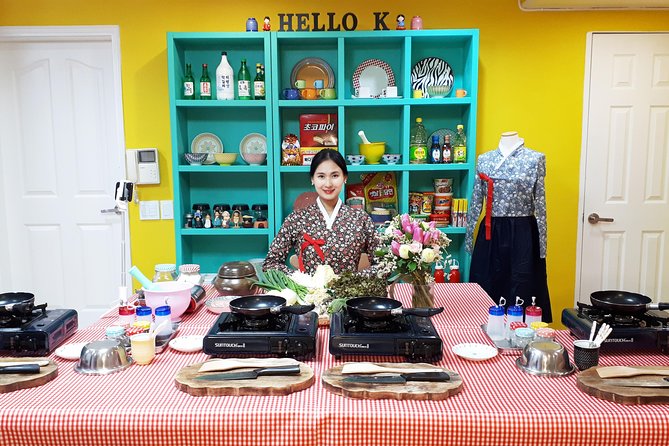
After the market, you go to the host’s home for the cooking class. This is the experience’s most personal feature. Instead of learning in a restaurant kitchen or a large commercial studio, you cook in the setting where home food makes sense.
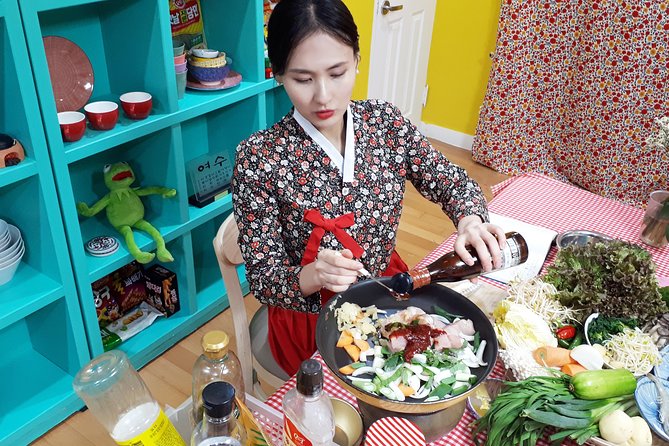
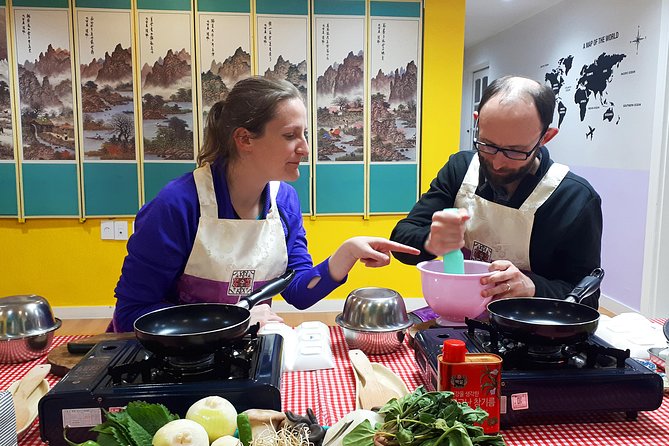
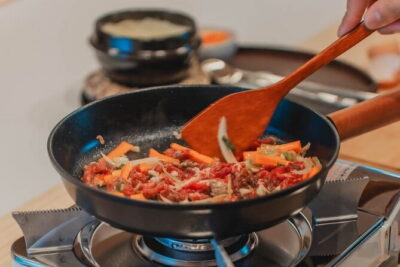
The class is described as 100 percent hands-on. You should expect to take part in preparing four Korean dishes, with examples including bibimbap rice and dakgalbi. Since the specific menu can change, you should not book this experience only because you need one exact recipe. Book it for the chance to learn a selection of well-known Korean dishes and the methods behind them.
Bibimbap gives you a useful introduction to arranging rice with vegetables and other toppings. Dakgalbi offers a different style of Korean cooking, built around a seasoned main ingredient and a bold sauce. Together, dishes like these show why Korean meals are not limited to one flavor or one cooking method.
The teaching style is aimed at ordinary cooks, not professionals. Guests are shown how to keep the recipes manageable, and several useful tips are shared along the way. You also learn basic Korean words and phrases, which can make the class feel more connected to the place rather than like a cooking lesson that could happen anywhere.
Sarah and Junghee are both praised for clear English, patience, and an easy way of explaining steps. That matters when a recipe includes unfamiliar ingredients or techniques. A good host can tell you not just what to do, but why a certain ingredient is used or how the dish fits into Korean food culture.
The atmosphere appears to be one of the class’s strongest points. The host tells personal stories, asks about your trip, and keeps the group involved. You may spend as much time laughing and talking as chopping and stirring. That is a plus for couples, families, and groups of friends who want a social activity.
It is also suitable for non-cooks. You do not need advanced kitchen skills to take part, and the class is designed to make the dishes feel possible at home. Families with older children and teenagers can enjoy the shared task, though parents should consider whether their children will be happy with a three-and-a-half-hour food-focused activity.
Sitting down to a Hanjeongsik feast
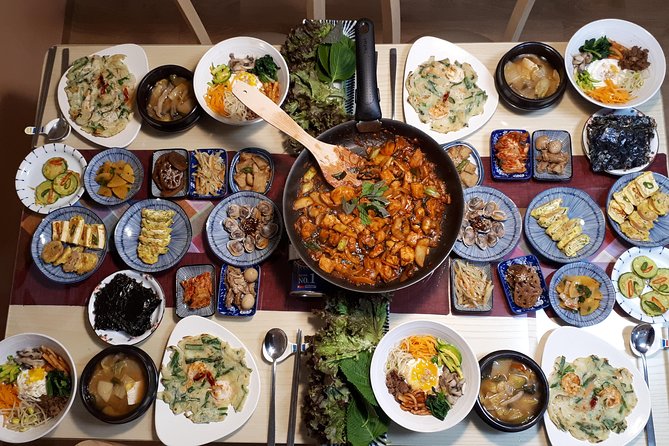
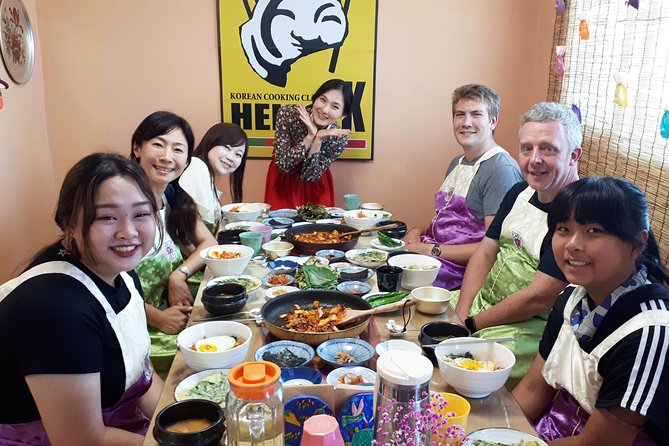
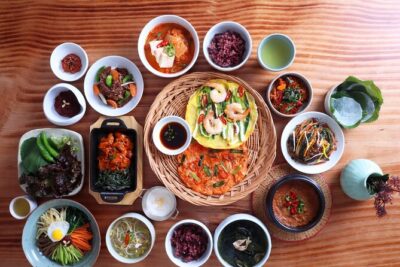
The class ends with the part many people will remember most: you sit down to eat what you prepared. Your dishes are served as part of a traditional Hanjeongsik-style meal, along with more than 10 additional side dishes, dessert, and a glass of makgeolli, Korean rice wine.
Hanjeongsik is valued for variety. Instead of one large plate arriving alone, the table fills with many smaller dishes that offer different tastes, colors, and textures. This helps you understand the Korean habit of eating rice and a main dish with a broad selection of accompanying banchan.
The extra side dishes also add value to the class. You are not paying $91 simply to prepare four recipes and eat those same four items. You receive a wider meal that shows how a Korean table is assembled at home. For someone trying Korean cuisine for the first time, this can be more useful than a restaurant meal because the host can explain what you are eating.
The makgeolli adds a traditional touch, although it is only one glass according to the description. If you do not drink alcohol, ask about the arrangement before booking, since the provided details do not specify a nonalcoholic substitute.
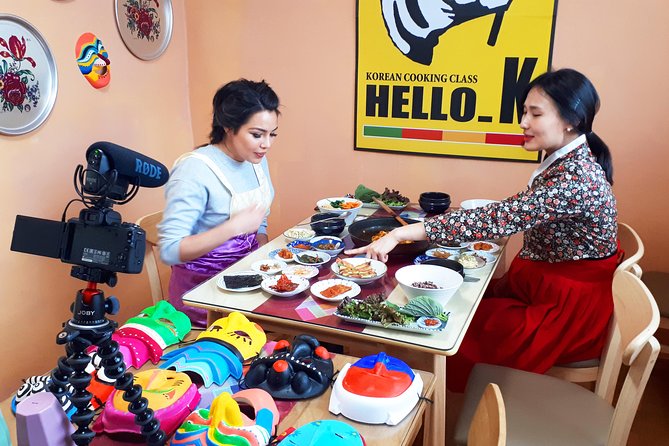
Dessert finishes the meal, and the shared table gives the class a natural ending. You can compare dishes with the other people in the group, ask final questions, and talk with the host about food in Seoul. In some cases, the host also takes photographs during the class and sends them afterward, giving you a record of the afternoon.
I would schedule this experience when you are hungry but not rushed. A large meal after active cooking can be filling, and you may want a slower evening afterward rather than another food stop.
Same country, a completely different kind of day:
- Best DMZ Tour Korea from Seoul (Red Suspension Bridge Optional)
★ 5.0 · 41,422 reviews - DMZ Tour: 3rd Tunnel, Option(Suspension Bridge, Boat) from Seoul
★ 5.0 · 21,373 reviews - DMZ tour south Korea from Seoul (NK experience hall, defector)
★ 5.0 · 20,599 reviews - Seoul: DMZ Tour with Optional Suspension Bridge
★ 4.8 · 5,277 reviews
What the $91 price buys you
At $91 per person, this is not the least expensive way to eat Korean food. You can buy a market snack or a restaurant meal for much less. The price makes more sense when you count the complete package: a guided market visit, street-food samples, ingredient instruction, a four-dish cooking class, a home setting, a large Hanjeongsik dinner, dessert, and makgeolli.
You also get access to a local host who can answer questions that a restaurant menu cannot. You can ask how an ingredient is used, learn a few Korean food terms, and take recipes home for another attempt. That personal instruction is the main reason to choose this over simply booking dinner.
The value is strongest if you intend to cook Korean food after your trip. Practical hints about shopping, seasoning, and preparation can continue paying off once you return home. It is also a good use of time for a first or second visit to Seoul, when you want an activity that combines food with local culture.
The value is weaker if you dislike group activities, are not interested in cooking, or want a highly specialized class focused on one dish. The menu is described with examples rather than a guaranteed list, so confirm any dietary or menu needs before paying.
Who will enjoy this Seoul food experience
I would recommend this class to couples who want a shared activity, families with older children, and friends who enjoy eating and chatting. It also suits solo visitors who like meeting people in a small group. The maximum of 10 participants keeps it personal without making it a private tour.
It is a good choice for first-time visitors who want context for Korean food. The market walk helps you recognize ingredients, while the home meal explains how many dishes fit together at the table. You leave with both food memories and information you can use elsewhere in Seoul.
The class may also work well for repeat visitors who have already seen the palaces and shopping districts. Mangwon Market and a local home offer a different view of the city. You are spending time with food rather than only looking at landmarks.
I would be more cautious about booking it for young children who cannot manage a long meal or for anyone with strict dietary restrictions. The available details do not specify vegetarian, vegan, gluten-free, allergy-friendly, or halal options. Contact the provider before booking if ingredients matter to your health or faith.
Practical details that affect your day
The activity includes a mobile ticket, and confirmation is provided when you book. Meet at Mangwon Station Entrance 2 and expect the experience to return to that same meeting point.
The tour is near public transportation, which makes the start and finish straightforward. Since you first walk through a market and then cook in a home, comfortable clothing and shoes are sensible. You will want enough room in your schedule for the market, cooking, eating, and conversation.
Free cancellation is available if you cancel at least 24 hours before the local start time. Cancellations or changes made less than 24 hours ahead are not accepted for a refund. That policy is fairly flexible, but check the local time in Seoul if you are booking from another time zone.
The activity has been booked more than 10 times in a recent week and carries a five-star rating from 1,024 published ratings, with 100 percent recommending it. Those figures suggest strong demand, so I would not leave it until the last day of a short Seoul visit.
Should you book this Mangwon cooking class?
Book it if you want Korean food explained through real ingredients, a friendly host, and a meal you help prepare. The combination of Mangwon Market, hands-on cooking, homemade side dishes, and a local home setting gives you more cultural context than a standard restaurant visit.
Skip it if you want a quick activity, a fixed single-dish lesson, or a formal culinary course. The class is social, the menu may vary, and the three-and-a-half-hour schedule requires a real commitment.
For most food-minded visitors, I see the $91 price as fair because the experience covers much more than the cooking itself. You taste the market, learn how Korean meals are put together, eat a generous spread, and leave with recipes and practical ideas for your own kitchen. That is a satisfying way to spend an afternoon in Seoul.
FAQ
Where does the experience begin?
The meeting point is Mangwon Station Entrance 2, at 377-20 Mangwon-dong, Mapo-gu, Seoul, South Korea.
Where does the experience end?
The activity ends back at the meeting point.
How long does the cooking class and market visit last?
The experience lasts approximately three hours and 30 minutes.
How many people can join?
The maximum group size is 10 people.
What happens during the market visit?
Your host guides you through a local market, explains Korean street foods and ingredients, discusses herbs and spices, and includes street-food tastings.
How many dishes do participants prepare?
You prepare four Korean dishes. Examples include bibimbap rice and dakgalbi, though the exact dishes may vary.
What is included in the final meal?
You eat your prepared dishes with more than 10 additional side dishes, dessert, and a glass of makgeolli, Korean rice wine.
Can I cancel for a full refund?
Yes. You can cancel at least 24 hours before the experience’s start time for a full refund. Cancellations or changes made less than 24 hours before the start time are not accepted for a refund.
More Workshops in Seoul
- Yongpyong Ski Resort from Seoul with Optional Lesson and Packages
★ 5.0 · 217 reviews - Korean Cooking Class with Grocery Shopping at Seoul Local Market
★ 5.0 · 107 reviews - Royal Seoul Cooking Class in a 100-Year-Old Hanok
★ 5.0 · 81 reviews - Seoul : Taste of Korea, Authentic Home-Style Cooking Class
★ 5.0 · 64 reviews
More Shopping Tours in Seoul
- Seoul Street Food Market Tour
★ 5.0 · 1,226 reviews - Seoul: Night Market Food Tour with Local Guide
★ 4.9 · 943 reviews - Private DMZ Tour (No Shopping): 3rd Tunnel & Suspension Bridge
★ 5.0 · 607 reviews - Downtown Seoul Guided Food & Market Tour with 8+ Local Tastings
★ 5.0 · 580 reviews
Just added around Seoul
- Gyeongbokgung palace,seoul with gigibebe hanbok rental★ 4.5 · 12 reviews
- Private tour guide service in Seoul, Korea★ 5.0 · 6 reviews
- Alpaca, Nami, Petite Fr, Italian Village, Garden of Morning Calm★ 3.5 · 5 reviews
- Gyeongju UNESCO Sites Tour by KTX train; The Museum Without walls★ 4.5 · 11 reviews
- Private day trip to Korean Folk Village & Dae Jang Geum Park★ 5.0 · 7 reviews
- Private tour Lotte World,Tower,Aquarium(All Tickets are included)★ 5.0 · 12 reviews
- Full Day Private Seoul Tour for foodies★ 5.0 · 3 reviews
- Seoul Private Custom Walking Tour with A Guide (Private Tour)★ 4.5 · 28 reviews
Cooking Classes, compared.
Master Korean traditional cooking with a Kimchi chef
Read our review →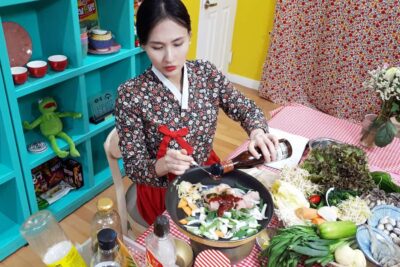
Korean Cooking Class at a Local Home and Market Tour
Read our review →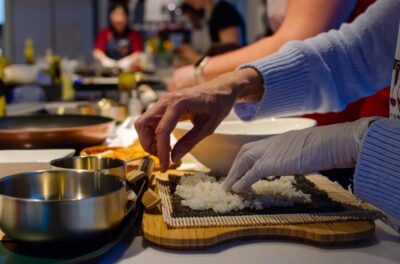
Korean Cooking Class with Grocery Shopping at Seoul Local Market
Read our review →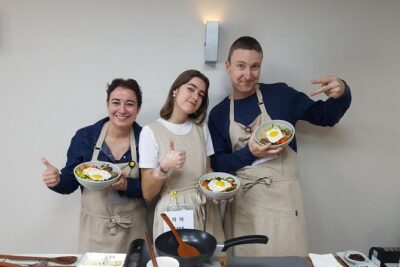
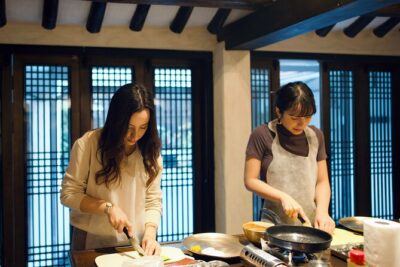
Royal Seoul Cooking Class in a 100-Year-Old Hanok
Read our review →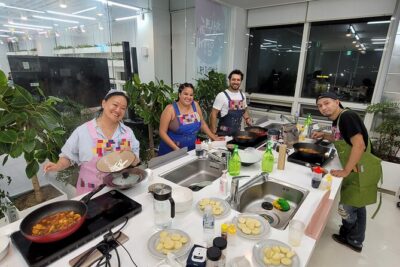
Busan Tailored Korean cooking class (Vegan OK)with market tour
Read our review →Browse the lists this tour appears in