
Reviewed · UNESCO WORLD HERITAGE TOURS
Gyeongju UNESCO Sites Tour by KTX train; The Museum Without walls
Gyeongju is the place to see Korea’s Silla kingdom in the open air. This private day trip links royal tombs, a thousand-year-old temple, a hilltop Buddhist grotto, and palace ruins, all reached from Seoul by fast KTX train.
I like the private format, which lets your guide adjust the pace and explain the sites to your group rather than to a busload of strangers. I also like the careful station help, including pickup in Seoul and an escort to the train, a useful touch for an early start.
The tradeoff is simple: it is a long day, with roughly two hours each way by train and six major stops once you reach Gyeongju. Rain can also make the day less enjoyable because several of the best sights are outdoors.
Key points to know before booking
- KTX makes Gyeongju possible in one day: The fast train saves you from a long road journey, though the round trip still takes a good part of the day.
- The tour covers Silla from several angles: You see royal burial mounds, courtly architecture, Buddhist art, astronomy, and palace gardens.
- Seokguram adds the best highland view: The grotto sits about 750 meters above sea level and looks toward the East Sea.
- Your group stays private: Only your party takes part, with an English-speaking local guide.
- Hotel pickup is included, but drop-off is not: The tour begins with Seoul-area pickup and ends without hotel return service.
- The price reflects transport and convenience: At $470 per person, the tour is costly, but it includes KTX fares, admission, a private vehicle, and a guide.
Why Gyeongju makes a strong day trip from Seoul
Seoul is Korea’s modern center, but Gyeongju tells an older story. For nearly a thousand years, it served as the capital of the Silla kingdom. The city is filled with remains from that period, and many are not behind museum glass. They appear as grassy burial mounds, stone pagodas, old foundations, ponds, and hillside sanctuaries.
That is the idea behind the tour’s museum without walls theme. You do not study Silla only through labels and display cases. You move through the places where royal families were buried, Buddhist worship took place, and palace ceremonies were held.
The route gives you a useful spread of Silla culture. Cheonmachong introduces the royal tombs. Gyeongju National Museum explains the objects found in and around them. Cheomseongdae shows the kingdom’s interest in the stars. Donggung Palace and Wolji Pond bring court life into view. Bulguksa and Seokguram show the scale and skill of Silla Buddhism.
You should expect a history-heavy day. If ancient Korea interests you, the range is excellent. If you prefer cafés, shopping, or a slow walk through one neighborhood, this schedule may feel packed.
More UNESCO World Heritage Tours in Seoul
- Day Trip to UNESCO: Suwon Fortress Adventure from Seoul
★ 5.0 · 56 reviews - DMZ Tour, 2nd Tunnel & UNESCO Suspension Bridge Tour from Seoul
★ 5.0 · 48 reviews - Namhansanseong UNESCO Historical Sites and Korean Folk Village-Private Tour
★ 5.0 · 29 reviews
The 7:00 am start and KTX ride
The day begins around 7:00 am with pickup at your Seoul hotel or accommodation area. The included private vehicle transfer takes you to the station, and the local escort can help you reach the platform and find your seats. That assistance matters because the departure is early and the train portion is arranged for you.
The KTX fare is economy class and included in the tour price. The ride to Gyeongju takes about two hours, giving you a comfortable break before the sightseeing begins. You should treat that train time as part of the day, not as a minor transfer.
The arrangement has earned especially strong praise for organization. Guides and escorts have helped groups from pickup through boarding, while the Gyeongju guide meets you after arrival. People named in past tours include Jay, Andrew, John, and Dylan. The guide assigned to your booking may be different, but the experience has clearly depended heavily on the individual leading the day.
English ability has generally been good enough for history-focused touring, though one account found an accent difficult to follow. If you want detailed explanations, ask questions early and tell your guide what interests you most. A private tour gives you room to do that.
Cheonmachong Tomb and the royal burial grounds
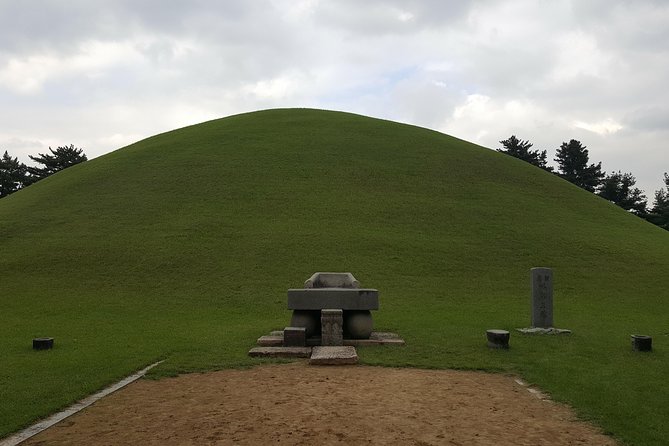
Your first major stop is Cheonmachong Tomb, part of an area containing more than 20 large and small Silla-era tombs. These rounded earthen mounds are believed to hold kings and court officials. Their quiet grassy shapes make a sharp contrast with Seoul’s dense streets.
Cheonmachong is especially useful as an opening stop because it gives you a physical sense of Silla power. The tombs are not tiny markers. They are large mounds built to protect elite burials, and their placement across the area makes the old capital feel close at hand.
You can also enter an excavated burial mound here. That detail gives the site more meaning than simply viewing mounds from outside. You begin to understand that archaeology is not an abstract subject in Gyeongju. It is part of the ground beneath your feet.
The stop lasts about an hour and admission is included. Wear comfortable shoes because the route involves walking outdoors. On a wet day, the grass and paths may be less pleasant, and the outdoor setting offers little shelter.
Gyeongju National Museum puts the ruins in context
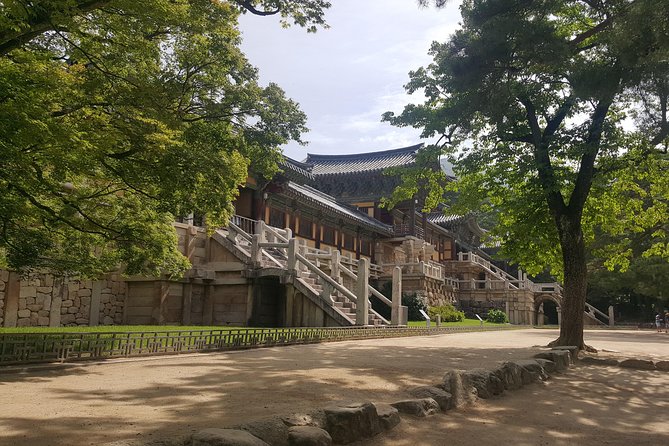
The National Museum is arguably the strongest single history stop on the route. Its main archaeological hall displays Silla objects, including ornate ceremonial pieces and finds connected with the ancient capital.
This is where the morning’s tombs begin to make sense. After seeing burial mounds, you can look at the objects placed inside them and consider the wealth, craft, and ritual surrounding Silla rulers. The museum turns scattered ruins into a story with human detail.
I like the balance between outdoor archaeology and indoor collections. The museum provides a visual break from walking, which is welcome on a full schedule. It also helps you notice details at later stops, such as the importance of Buddhist sculpture and the care given to royal settings.
Admission is included, and the planned visit is about an hour. The museum is not just a backup for bad weather. It is one of the places that gives the entire tour its structure.
Same country, a completely different kind of day:
- Best DMZ Tour Korea from Seoul (Red Suspension Bridge Optional)
★ 5.0 · 41,422 reviews - DMZ Tour: 3rd Tunnel, Option(Suspension Bridge, Boat) from Seoul
★ 5.0 · 21,373 reviews - DMZ tour south Korea from Seoul (NK experience hall, defector)
★ 5.0 · 20,599 reviews - Seoul: DMZ Tour with Optional Suspension Bridge
★ 4.8 · 5,277 reviews
Cheomseongdae, the old star-gazing tower
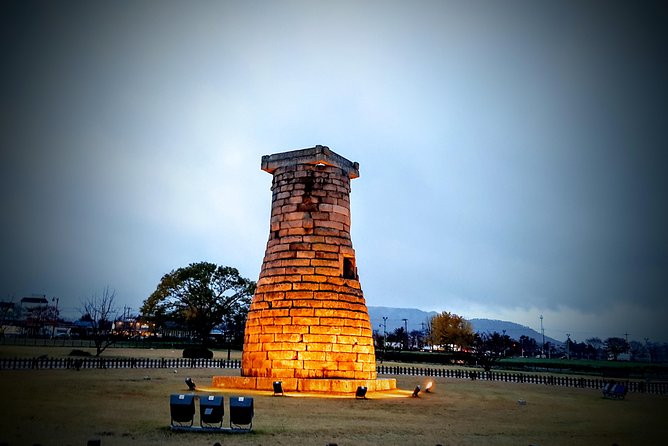
Cheomseongdae means Star Gazing Tower. Built during the reign of Queen Seonduk in 634, it is described as the oldest existing observatory in the Far East. Its 27 levels of stone create a compact, unusual structure that is easy to see but more rewarding once your guide explains its age and purpose.
This stop is brief in visual scale but important in meaning. Silla was not only a kingdom of tombs and temples. Its rulers also supported observation of the sky and the ordering of time. Cheomseongdae adds science and royal administration to the story.
The admission is free, and the visit lasts about an hour. You will view the tower from outside, so the experience depends on weather and your guide’s explanation. It is near other historic areas, which helps the schedule move along without adding another major transfer.
Donggung Palace and Wolji Pond after dark in spirit
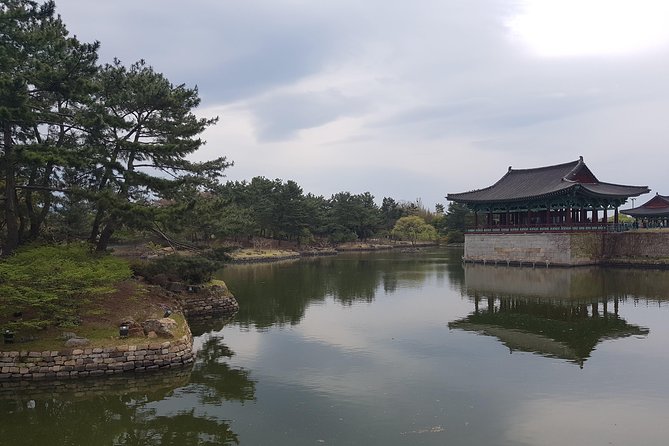
Donggung Palace and Wolji Pond, formerly known as Anapji Pond, show the ceremonial side of Silla life. The pond was built in 674 after the unification of the Korean Peninsula. Artificial hills, trees, flowers, birds, and animals were brought into the palace grounds to create a designed royal setting.
The site is more than a water feature. It reflects how the court shaped nature for banquets, ceremonies, and palace life. The remaining foundations and pond give you enough to picture the original setting, even though much of the palace is gone.
Admission is included, and the planned stop is about an hour. The grounds are outdoors, so rain can affect your enjoyment. Still, the pond adds variety after the museum and tombs, and it is one of the more visually appealing parts of the route.
The name change can cause a little confusion. Anapji Pond is the older name, while Donggung Palace and Wolji Pond is the current name used for the site. Knowing both names helps when you look at maps or signs.
Bulguksa Temple and Silla Buddhist design
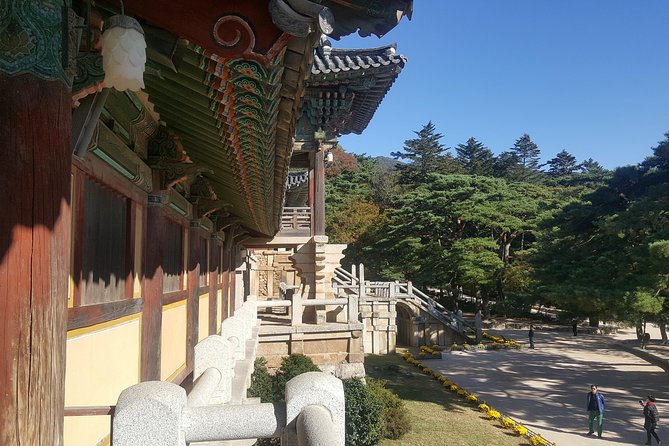
Bulguksa is Korea’s best-known Buddhist temple and one of the day’s central stops. The temple holds important Silla-period relics, including the stone pagodas Dabotap and Seokgatap. Their different designs give you a good chance to compare Silla ideas about balance, decoration, and simplicity.
The temple is not a single object to inspect and leave. It is a group of gates, courtyards, steps, halls, and stone details. Your guide can point out what belongs to the Silla period and what has been repaired or rebuilt over time, an important distinction at a major historic site.
Bulguksa also prepares you for Seokguram. The two sites are connected as part of the same Buddhist complex, but they offer very different experiences. Bulguksa is architectural and open, while Seokguram is a smaller sacred space high in the hills.
Admission is included, and the visit is scheduled for about an hour. Expect walking and steps. If mobility is a concern, ask about the exact route before booking, since the provided information confirms that most people can participate but does not give a detailed accessibility plan.
Seokguram Grotto and the East Sea view
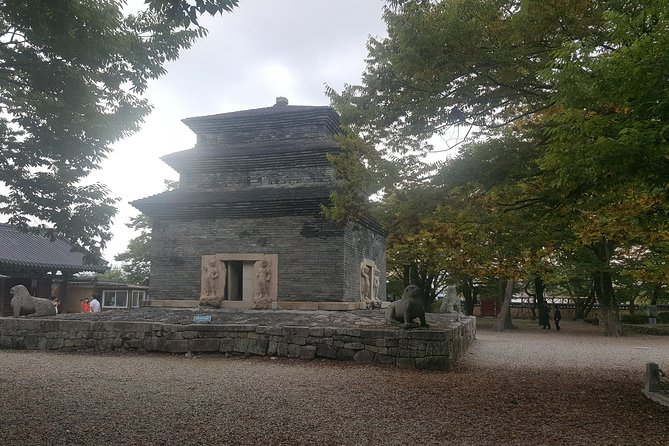
Seokguram Grotto is a hermitage associated with Bulguksa. It sits about 750 meters above sea level and looks toward the East Sea. The setting alone makes it feel different from the city sites below.
Inside, the grotto holds Buddhist sculptures regarded among the finest in the world. The central figure and surrounding carvings show the artistic ambition of Silla Buddhism, while the controlled space gives the visit a quiet, focused quality.
The stop is planned for about an hour and admission is included. The road up from Bulguksa adds travel time, but it is worthwhile because the grotto gives the tour its strongest highland setting. Weather matters here too. Fog or rain may limit the view, and wet conditions can make the visit less comfortable.
This is one place where a guide adds real value. A quick look at a sculpture cannot tell you why the grotto was built or how it relates to Bulguksa. Ask for the religious and artistic background if that is important to you.
How much value is in the $470 price?
The listed price is $470 per person. That is a serious cost for a day trip, especially if you are traveling alone or as a couple. The value depends on how much you would otherwise spend arranging the same day yourself.
The fee includes Seoul-area hotel pickup, a private vehicle transfer, round-trip KTX economy fare, an English-speaking guide, and all admission fees. It does not include meals or hotel drop-off in Seoul. Group discounts may be available, and the private format means the price can make more sense for a small group sharing the experience.
I see the main value in time and reduced stress. You do not need to buy the train tickets, coordinate a Gyeongju vehicle, find each site, or work out the order. The station escort is also useful for a 7:00 am start.
Lunch is not included. One guide took a group to a small local restaurant where the portions were generous and the food was well received. That kind of stop may be part of your guide’s approach, but you should budget separately for food and not assume a meal is included.
The long-day question
The tour lasts about eight to nine hours, but the early start and train ride make it feel like a full day away from Seoul. You will cover six major stops, and each is allotted about an hour. That gives you broad coverage rather than long, quiet visits.
I would book it for a first look at Gyeongju when you have limited time in Korea. The route covers the key themes and removes much of the planning work. I would not choose it if your ideal day includes lingering at one temple, taking long photographs, or exploring side streets at your own pace.
The weather forecast deserves attention. A rainy day can weaken the experience because tombs, Cheomseongdae, the pond, Bulguksa, and Seokguram all involve outdoor time. The company has accommodated time changes in at least one case, but any changes made less than 24 hours before departure are not accepted under the stated policy.
The tour has a 91 percent recommendation rate and a 4.6 rating from 11 ratings. The strongest praise centers on organization, caring station assistance, and guides who bring Silla stories to life. The main cautions are the length of the day, rain, and the possibility that an accent may make detailed English explanations harder to follow.
Who should book this Gyeongju tour?
I recommend it most strongly for history fans, first-time visitors to Korea, and small groups that want private attention. Families and older visitors may also appreciate having the train, vehicle, admissions, and guide arranged together, though the amount of walking should be considered.
It suits you if Gyeongju is high on your list but you cannot spare an overnight stay. It also suits you if you want more than a photo stop, since the museum and guide connect the sites into one Silla story.
You may want a different plan if price is your main concern. Independent visitors can seek out public transport and individual admission, though that requires more planning and may limit how much you see in one day.
Should you book it?
Book this tour if you want the widest useful introduction to Gyeongju in one day and value having the complicated parts handled. The KTX ride is comfortable, the private vehicle saves time between sites, and the route gives you tombs, a museum, a palace pond, a temple, and a mountain grotto.
Skip it if you dislike early starts or long day trips. If you can stay overnight in Gyeongju, a slower visit would let you spend more time at each place. For a Seoul-based itinerary, though, this is a practical way to reach Korea’s Silla capital without giving up a hotel night.
Free cancellation is available when you cancel at least 24 hours before the local start time. The experience may also be canceled if its minimum number of participants is not met, in which case you are offered another date or a full refund.
FAQ
How long does the Gyeongju tour last?
The experience lasts approximately eight to nine hours, including the journey from Seoul and the sightseeing in Gyeongju.
What time does the tour begin?
The scheduled start time is 7:00 am.
Is hotel pickup included?
Yes. Pickup is offered from Seoul-area hotels and accommodations.
Is hotel drop-off in Seoul included?
No. The tour includes pickup, but hotel drop-off service in Seoul is not included.
How do you travel from Seoul to Gyeongju?
You travel by round-trip KTX high-speed train in economy class. A private vehicle is used for transfers connected with the tour.
Are train tickets included in the price?
Yes. Round-trip KTX economy-class fare is included.
Are admission fees included?
Yes. Admission fees to the tourist sites listed in the tour are included.
Is this a private tour?
Yes. Only your group participates in the private activity.
Is cancellation free?
You can cancel for a full refund if you cancel at least 24 hours before the experience start time. Cancellations or changes made less than 24 hours before the start are not accepted for a refund.
More Museums in Seoul
- Seoul: War Memorial of Korea Private Guided Museum Tour
★ 4.9 · 29 reviews - DMZ Tour + The War Memorial of Korea Museum
★ 5.0 · 28 reviews - Color Pool Museum
★ 4.0 · 22 reviews - SEOUL: Gugak – Korean Traditional Music Museum&Concert Tour
★ 4.7 · 17 reviews
More Train Experiences in Seoul
- Busan: Coastal Treasures Beach Train, Culture Village & More
★ 4.7 · 832 reviews - Busan’s Cultural Wonders with Beach Train & Gamcheon Village etc
★ 4.5 · 663 reviews - Busan city tour from Seoul by KTX bullet train
★ 5.0 · 39 reviews - Busan day trip including Gamcheon culture village from Seoul by KTX train
★ 5.0 · 3 reviews
Just added around Seoul
- Gyeongbokgung palace,seoul with gigibebe hanbok rental★ 4.5 · 12 reviews
- Private tour guide service in Seoul, Korea★ 5.0 · 6 reviews
- Alpaca, Nami, Petite Fr, Italian Village, Garden of Morning Calm★ 3.5 · 5 reviews
- Private day trip to Korean Folk Village & Dae Jang Geum Park★ 5.0 · 7 reviews
- Private tour Lotte World,Tower,Aquarium(All Tickets are included)★ 5.0 · 12 reviews
- Private day tour Korea(Seoul trip) with Professional Photographer★ 5.0 · 6 reviews
- Full Day Private Seoul Tour for foodies★ 5.0 · 3 reviews
- Seoul Private Custom Walking Tour with A Guide (Private Tour)★ 4.5 · 28 reviews
UNESCO World Heritage Tours, compared.
Gyeongju UNESCO World Heritage Guided Day Tour
Read our review →
East Jeju Essentials – Seongsan Ilchulbong (UNESCO) & Haenyeo
Read our review →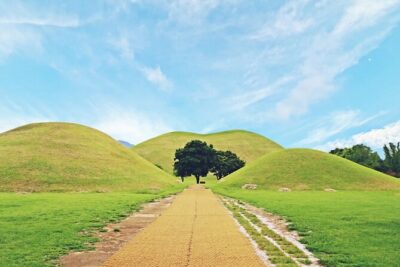
Gyeongju UNESCO World Heritage Guided Day Tour from Busan
Read our review →
Jeju Southern UNESCO Full Day Tour with Mt.Halla
Read our review →
Jeju island Southern UNESCO Day Tour With Hallasan MT
Read our review →Browse the lists this tour appears in