
Reviewed · UNESCO WORLD HERITAGE TOURS
Gyeongju UNESCO World Heritage Guided Day Tour from Busan
Gyeongju is South Korea’s great open-air history book, and this long day trip lets you read several of its best chapters without arranging buses and admission tickets yourself. You’ll see Bulguksa Temple, royal tombs, old bridges, village lanes, and the beautifully lit Wolji Pond, depending on the route you choose.
I like the air-conditioned transport from central Busan and the choice between a wider UNESCO-focused route and a museum option. Guides such as Vincent, Sol, Irene, Bobby Kim, and Roy are praised for clear explanations, good timing, and help with photos. The catch is the length: expect roughly 10 to 12 hours, with plenty of walking, outdoor time, and some long stretches on the bus.
At a glance
- Two routes suit different interests: Choose the UNESCO Tour for Yangdong Village, royal tombs, Woljeonggyo Bridge, and Donggung Palace and Wolji Pond, or the Museum Tour for the Gyeongju National Museum.
- Bulguksa anchors both options: You get about 1 hour and 10 minutes at one of Korea’s finest Silla-era Buddhist sites.
- The day runs late: The final sights may be seen after sunset, especially Donggung Palace and Wolji Pond, while traffic can push the return toward 9 p.m.
- Most stops are outdoors: Bring clothing for changing temperatures, comfortable shoes, and protection from sun or rain.
- Meals are not included: Lunch and dinner are paid separately, so vegetarians and anyone with a large appetite may want a backup plan.
- The group can be large: The coach may hold up to 43 people, though several guides help keep the day moving.
Why Gyeongju makes a strong day trip from Busan
Gyeongju was the capital of the Silla Kingdom for centuries, and its old royal center is spread across a broad area rather than packed into one compact historic district. That makes independent sightseeing possible, but it also means more planning and more time spent figuring out transport between temples, tombs, villages, and museums.
This tour solves that problem in a practical way. You board in central Busan, ride in an air-conditioned coach or minivan, and let the guide handle the route. Admission is included for the main paid sights on the UNESCO route, including Yangdong Village, Donggung and Wolji, and the Cheonmachong Tomb section of Daereungwon.
The tradeoff is control. You will not linger wherever you please, and a group of up to 43 people cannot move at the pace of a private tour. Still, if Gyeongju is a priority and you have only one free day from Busan, this is an efficient way to see the area’s major sights.
More UNESCO World Heritage Tours in Busan
- From Busan: Gyeongju UNESCO World Heritage Guided Day Tour
★ 4.8 · 1,250 reviews - From Busan to Gyeongju UNESCO Legacy Tour with National Museum
★ 5.0 · 87 reviews - Gyeongju The UNESCO World heritage sites tour(Private tour)
★ 5.0 · 17 reviews
Picking between the UNESCO and Museum tours
The UNESCO Tour is the better choice if you want variety. It combines a living traditional village, a major Buddhist temple, ancient tombs, a restored bridge, and a palace pond. You get more outdoor scenery and more chances to see Gyeongju as a place rather than only as a collection of museum objects.
The Museum Tour is more focused. It includes Bulguksa, Hwangnidan-gil Street, and the Gyeongju National Museum. This makes sense if you prefer objects, architecture, and indoor interpretation, or if hot, cold, or rainy weather makes a full day outside less appealing.
The two routes share Bulguksa and Hwangnidan-gil, but they do not offer the same experience. Check the exact option carefully before booking. The most frequently praised moments on the UNESCO route are the village, the evening pond, and the mix of temple, tomb, and palace sites.
Bulguksa Temple: start with Silla craftsmanship
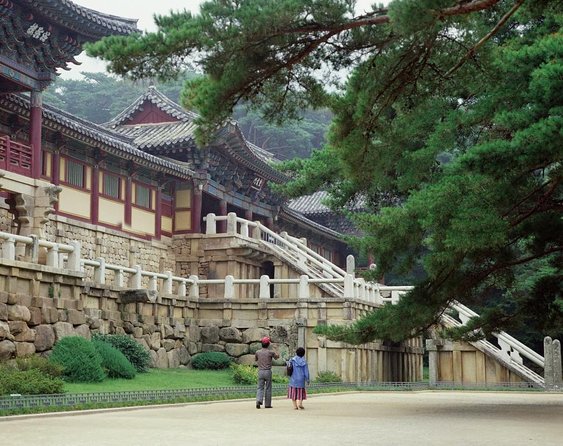
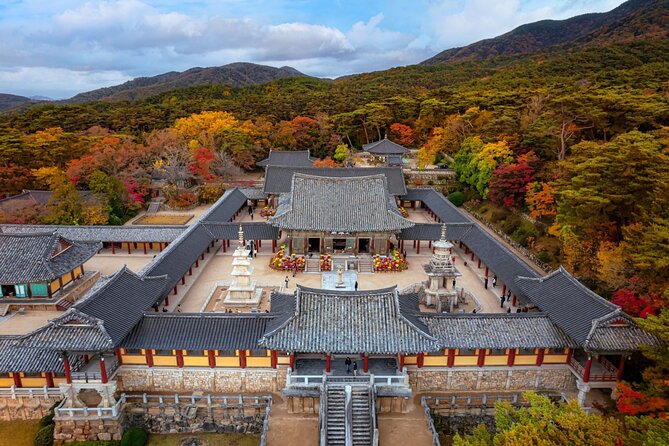
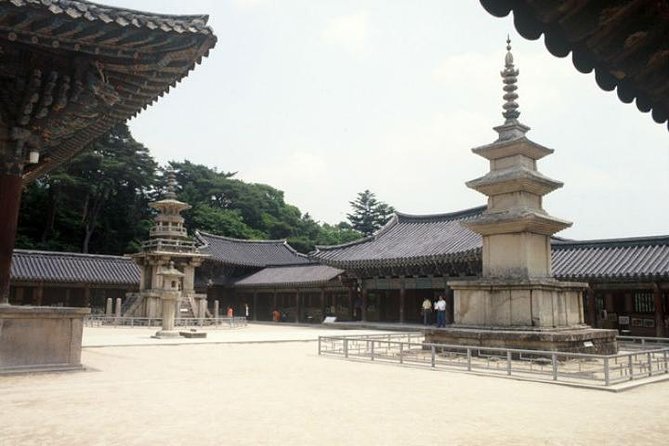
Bulguksa is the first major stop, with about 1 hour and 10 minutes on site. Originally built in the eighth century, the temple is one of Korea’s most important Buddhist complexes and a UNESCO World Heritage site.
This is not simply a quick photo stop. The stone platforms, stairways, pagodas, and carefully arranged courtyards show how Silla builders joined religious ideas with fine workmanship. Your guide can give the site a useful frame before you explore on your own, which helps you notice details that can be easy to miss when you arrive without context.
The main limitation is time. An hour is enough to see the key areas and take photographs, but it is not enough for a slow architectural study. One itinerary assessment found the larger stops, including Bulguksa, somewhat rushed. Wear shoes that handle steps and uneven ground, and expect much of the visit to be outside.
Yangdong Folk Village: the most atmospheric stop
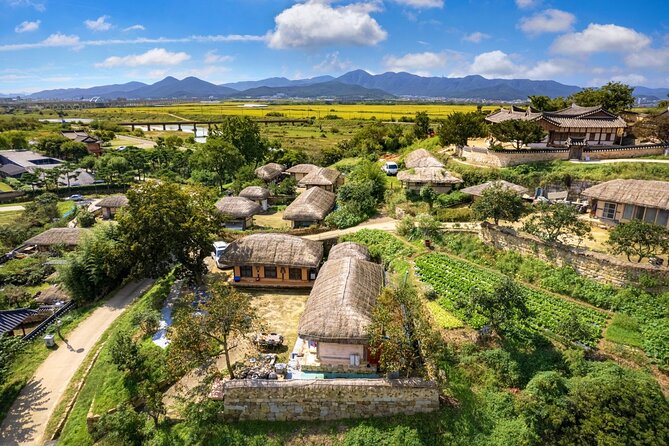
The UNESCO route spends about 2 hours and 15 minutes at Yangdong Folk Village. This is the longest stop and, for many people, the most distinctive part of the day.
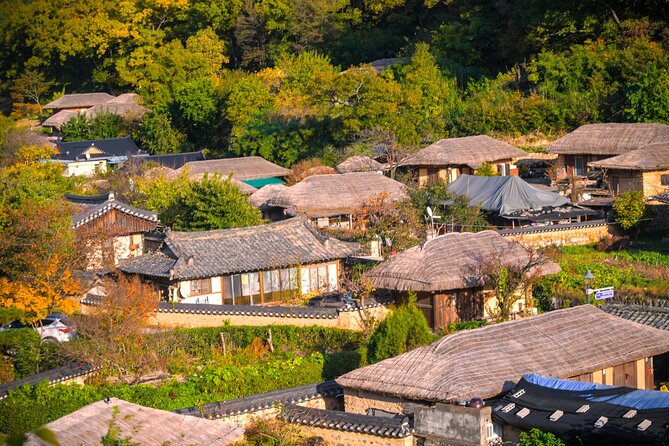
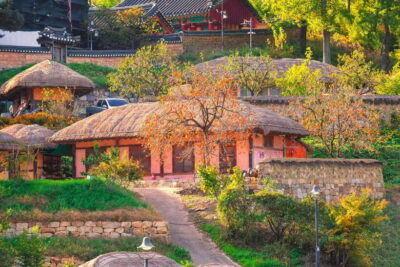
Yangdong is Korea’s largest and best-preserved traditional village of its kind, set among mountains and rolling rural scenery. Its houses, tiled roofs, walls, lanes, and hillside position offer a sense of how elite and working families lived in the Joseon period. Unlike a single restored building, the village feels like a whole settlement.
You should treat this as a walking visit, not a museum hallway. The lanes rise and fall, and the village covers enough ground that comfortable footwear matters. The group may spend part of the time together with the guide and part of the time exploring independently.
Food arrangements here need attention. Meals are excluded, and a detailed account described lunch at the village’s only cafe, with chicken, seafood, and pork choices and cash payment. Other accounts praised a traditional Korean meal, including a ginseng chicken set, while some found the portion small or the quality disappointing. The practical lesson is simple: do not assume lunch is included or that the food will suit every diet. If you are vegetarian, pack something unless the operator confirms a suitable choice.
Same country, a completely different kind of day:
- Busan: Gyeongju Guided Day Trip to Three Kingdoms Capital
★ 4.8 · 1,925 reviews - Small Group Full Day Busan Tour (Max 6 Pax)
★ 5.0 · 1,464 reviews - Busan Private Tour with licensed tour guide + private vehicle
★ 5.0 · 1,143 reviews - Busan: Coastal Treasures Beach Train, Culture Village & More
★ 4.7 · 832 reviews
Daereungwon and Cheonmachong: royal tombs without a grand palace
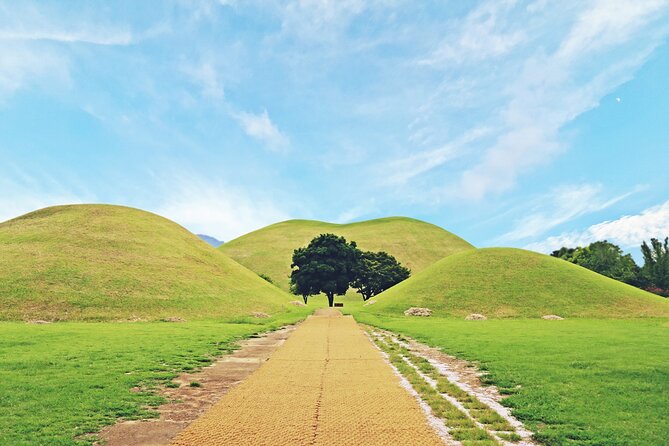
Daereungwon Tomb Complex gets about 45 minutes on the UNESCO route. The site contains 23 rounded tombs from the Silla period, rising like grassy hills across a city park.
The scale is what makes the stop memorable. These are not small markers but large burial mounds that once held kings, nobles, and valuable objects. The included Cheonmachong Tomb ticket allows access to one excavated tomb, where you can see how the mound was built and learn about the treasures found inside.
Forty-five minutes gives you time to walk among the main mounds and enter Cheonmachong, but it leaves little room for a leisurely circuit. The stop also connects directly with Hwangnidan-gil, making it easy to move from ancient burial grounds to modern cafes and shops.
Hwangnidan-gil: modern Gyeongju after the tombs
Hwangnidan-gil Street sits beside Daereungwon and offers a sharp change of mood. Traditional hanok buildings now hold cafes, food stalls, small shops, and restaurants. The tour allows about 45 minutes here, with no admission fee.
I like this stop because it shows that Gyeongju is not frozen in the Silla period. You can browse local snacks, try specialty coffee, or simply watch the old and new city overlap. It is also a useful meal stop, though dinner is at your own expense and is not prearranged.
Some people may find 45 minutes just right for a snack and short walk. Others may feel it is an awkward pause late in a long day, especially after already eating lunch. If you are tired, use the time for food and a seat rather than trying to cover every side street.
Woljeonggyo Bridge: a short but photogenic stop
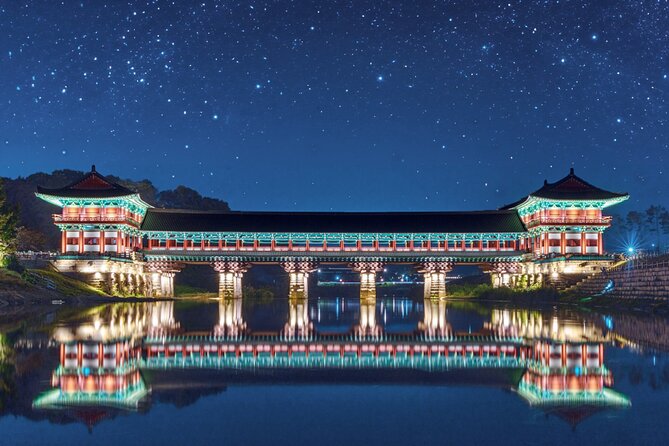
The UNESCO route includes about 20 minutes at Woljeonggyo Bridge. The original bridge dates back centuries, and the present structure reflects traditional Korean design with stone arches and large timber buildings.
Twenty minutes is brief, but the bridge works well as a photo stop. Its proportions and setting are easy to appreciate from the approach, and it can look especially attractive as daylight fades. You will not have time for a long walk or detailed study, so keep your expectations in line with the schedule.
This is one of the stops where the guide’s organization matters. A clear meeting point and a prompt return to the coach help protect time for the evening visit.
Donggung Palace and Wolji Pond after dark
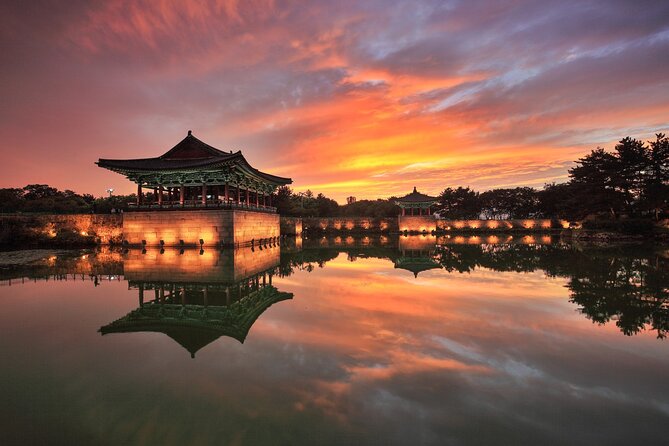
The UNESCO route ends its sightseeing at Donggung Palace and Wolji Pond, with about one hour at the site. The pond was created in 674 as part of the Silla royal complex, and the excavated palace buildings were later reconstructed around the water.
This is often the visual high point of the day. The pond, pavilions, and reflections take on a different character when illuminated, and several people have singled out the evening views as a reason to choose this tour. The contrast is pleasing: you begin with a working Buddhist temple and finish beside a royal pleasure garden.
The timing depends on the season, traffic, and the pace of earlier stops. You may arrive in daylight during longer summer evenings or after dark in winter. Bring an extra layer. The temperature can change during a day that moves from Busan to rural Gyeongju and ends outdoors at night.
The Museum Tour: fewer outdoor stops, more Silla objects
If you choose the Museum Tour, the Gyeongju National Museum replaces Yangdong Village, Daereungwon, Woljeonggyo Bridge, and Donggung and Wolji. You still visit Bulguksa and Hwangnidan-gil.
The museum houses important Silla objects, including golden crowns and Buddhist relics. It gives you a clearer look at the objects and beliefs behind the monuments you see elsewhere in Gyeongju. For anyone who wants more explanation than free-roaming at historic sites, this option may offer a better balance.
The museum admission itself is listed as free, while the UNESCO route includes paid admissions at selected locations. That does not automatically make the Museum Tour better value, since both involve transport and a full day of guiding, but it does make the route appealing if indoor exhibits matter more to you than village scenery and nighttime views.
The long day, bus time, and group size
The published duration is about 10 to 12 hours. Pickup times and return times can vary by stop, traffic, weather, and season. Some schedules begin around 9 or 9:20 a.m. and return around 8 or 9 p.m., so do not book a tight evening reservation afterward.
You will spend real time on the coach. That is not wasted time if you enjoy watching the Korean countryside pass by, but it can feel heavy after a full day of walking. Several guides have been praised for keeping a large group together and making the commentary easy to follow. Vincent, Sol, Irene, Bobby Kim, Roy, Tomy, and Lan are among the guides specifically praised for organization, history, kindness, or help with photographs.
The maximum group size is 43. That makes this a social, large-coach experience rather than a quiet private outing. The upside is a low price and a guide who can manage the route. The downside is waiting for people at meeting points and less time for personal exploration.
Food, clothing, and what to pack
Meals are not included. Plan on paying separately for lunch and dinner, and carry some food if you have dietary needs or prefer not to gamble on the available choices.
Clothing deserves more thought than it might on a city tour. About 95 percent of the stops are outdoors, and you will walk around temples, village lanes, tomb parks, bridges, and a pond. Pack:
- Comfortable walking shoes
- A layer for the evening
- Rain protection if the forecast is uncertain
- Water and a small snack
- Payment for meals and personal purchases
- A phone with the tour’s required communication access
One detailed account noted that WhatsApp and a Google account may be needed to take part fully, with workarounds possible. Confirm the communication instructions before departure so you are not sorting out technology at the first meeting point.
Is $57.14 a good price?
At $57.14 per person, the tour is priced as a budget-friendly way to reach a spread-out historic area from Busan. The fare covers round-trip coach or minivan transport, a guide in English, Chinese, or Korean, and selected admission fees. Considering the distance, the number of stops, and the difficulty of connecting them independently in one day, the value is strong.
The price does not cover meals, insurance, or personal expenses. If you buy both lunch and dinner, the final cost will be higher. Also remember that low cost comes with a large group, a fixed schedule, and limited time at major sites.
I would pay this price for the UNESCO route if Gyeongju is a must-see and I have only one day available. I would choose the Museum Tour if I value indoor exhibits and a more compact set of sights. A private tour could offer more freedom, but this option is far less expensive.
Who should book this Gyeongju day tour?
This tour suits you if you want to cover a lot of ground without renting a car or learning several regional bus routes. It is especially useful for first-time visitors to Korea who want a clear introduction to Silla history and the main Gyeongju sights.
It also works well for families and mixed-interest groups. One person can enjoy temple architecture, another can focus on food and cafes, and everyone gets a broad look at the city. The guides are often praised for answering questions, taking photos, and keeping the day on schedule.
I would hesitate if you dislike early starts, long bus rides, large groups, or fixed sightseeing windows. It is also not ideal for anyone wanting a slow lunch, extended museum time, or a quiet visit at each site. The day is full by design.
Should you book it?
Book the UNESCO Tour if you want the strongest first visit to Gyeongju: Bulguksa, Yangdong Village, royal tombs, Hwangnidan-gil, Woljeonggyo Bridge, and the evening glow of Wolji Pond. It packs in a lot, and the mix of sites is more memorable than a simple temple-and-museum outing.
Choose the Museum Tour if you prefer artifacts and indoor interpretation or want to reduce the number of outdoor historic stops. In either case, accept that this is a big day. Bring good shoes, extra clothing, meal money, and patience for the bus.
With a 4.8 rating from 660 reviews and 97 percent recommendation, the tour has a strong record. Its best qualities are practical: reliable transport, helpful guides, included admissions on the UNESCO route, and access to a historic city that is difficult to cover quickly on your own. Its main weakness is the same feature that makes it useful: the packed schedule. If you can handle that pace, this is a worthwhile Busan day trip.
FAQ
How long does the Gyeongju tour from Busan last?
The experience lasts approximately 10 to 12 hours. Traffic, weather, and the day’s pace can affect the exact return time.
Where does transportation depart from?
The tour provides round-trip travel from central Busan. Specific pickup details are provided at booking.
What type of vehicle is used?
Transport is provided by an air-conditioned coach or minivan. The maximum group size is 43 people.
Which languages are supported?
The tour offers an English, Chinese, or Korean-speaking guide.
What is included on the UNESCO Tour?
The UNESCO Tour includes transport, guiding, Yangdong Village admission, Donggung and Wolji admission, and the Cheonmachong Tomb ticket.
Is the Gyeongju National Museum included in both routes?
No. The Gyeongju National Museum is included on the Museum Tour only.
Are meals included?
No. Lunch and dinner are not included, and you pay for meals and personal purchases separately.
How much walking is involved?
Most stops are outdoors and include walking around temple grounds, village lanes, tombs, bridges, and a pond. Comfortable shoes are recommended.
Can most people take part?
The activity states that most people can participate. The itinerary can change because of traffic and weather conditions.
Can I cancel for a full refund?
You can cancel at least 24 hours before the experience start time for a full refund. Cancellations or changes made less than 24 hours in advance are not accepted for a refund.
More Historical Tours in Busan
- Old Korea Thousand History Tour of Gyeongju from Busan
★ 5.0 · 518 reviews - Busan history and market food tour with local chef
★ 5.0 · 58 reviews - From Busan: Echoes of Silla Gyeongju Historical Day Tour
★ 4.8 · 55 reviews - Gyeongju Historic Areas Day Tour with Sky Capsule from Busan
★ 5.0 · 18 reviews
Just added around Busan
- Real Busan Walking Experience★ 5.0 · 27 reviews
- 7 Highlights Gyeongju City One Day Small Group Tour from Busan★ 5.0 · 24 reviews
- Full Day Private car tour to UNESCO Gyeongju&Yangdong village★ 5.0 · 5 reviews
- Suncheon and Yeosu Daily Private Tour with Pickup Service★ 5.0 · 3 reviews
- Visit Busan night market and enjoy the night view of Busan harbor★ 5.0 · 6 reviews
- Busan Highlights Shore Tour – Cruise Return Assured★ 4.5 · 34 reviews
- Suncheon one day tour from Seoul, Busan or Suncheon★ 5.0 · 3 reviews
- Busan Beomeosa Temple & Hongbeopsa Temple with temple lunch★ 5.0 · 11 reviews
UNESCO World Heritage Tours, compared.
Gyeongju UNESCO World Heritage Guided Day Tour
Read our review →
East Jeju Essentials – Seongsan Ilchulbong (UNESCO) & Haenyeo
Read our review →
Jeju Southern UNESCO Full Day Tour with Mt.Halla
Read our review →
Jeju island Southern UNESCO Day Tour With Hallasan MT
Read our review →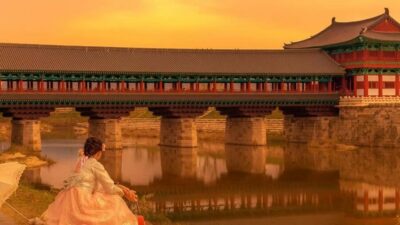
Gyeongju UNESCO Legacy Tour with National Museum
Read our review →Browse the lists this tour appears in