
Reviewed · UNESCO WORLD HERITAGE TOURS
Full Day Private car tour to UNESCO Gyeongju&Yangdong village
Gyeongju is the place in South Korea where ancient tombs, stone observatories, royal ponds, temples, and old village homes all fit into one day. This private car tour lets you connect the main sights without wrestling with local buses or choosing between far-flung sites. I especially like the flexible stop list and the chance to include Yangdong Village, a quieter contrast to central Gyeongju.
I also like that the vehicle, fuel, parking, tolls, guide, and pickup are covered in the price. Guides such as Park Jin Hyouck, Ted, and Kei have helped families with children and older relatives, suggested local restaurants, and adjusted plans when needed. The main caution is time: trying to see all ten listed stops would make the day feel rushed, and meals and attraction tickets are extra.
Key points to know before you book
- Private vehicle for up to eight people: The $430 group price can be good value for families or friends who would otherwise need several taxis or a costly private transfer.
- Choose your Gyeongju highlights: You can focus on Bulguksa, royal tombs, palace ruins, traditional villages, museums, or a mix.
- Yangdong Village adds a rural side of Korea: Its old homes and thatched cottages show Joseon-era life beyond the city’s royal monuments.
- A guide who also drives: Park Jin Hyouck, Ted, and Kei are named guides associated with the service, with help ranging from historical explanation to restaurant suggestions.
- Plan for a long day: The experience is advertised at about nine hours, while the customizable itinerary also refers to ten hours. Six major stops plus food is a more sensible goal than everything.
- Lunch and admissions need a budget: Fuel, tolls, parking, taxes, vehicle, and guide are included, but meals, personal spending, and attraction entrance fees are not generally covered.
Why a private car makes Gyeongju easier
Gyeongju covers a wide area, and its major sights do not form one tidy walking route. Bulguksa Temple sits away from the central tomb district, while Yangdong Folk Village requires another trip beyond the city. A private car saves the awkward parts of the day: waiting for buses, changing routes, and deciding how much time remains after every stop.
You can begin in Busan or Gyeongju, with pickup and drop-off at preferred places. The vehicle is air-conditioned, and fuel, parking, tolls, and the driver’s expenses are included. For a group of eight, $430 works out to about $54 per person before meals and admission fees. For two people, it is a much bigger spend, so the strongest value comes when a family or group fills the vehicle.
The guide is also your driver, which makes the day practical rather than formal. You can ask for a slower pace, include a meal stop in Hwangnidan-gil, or replace one sight with another place in Gyeongju. The service has used guides including Park Jin Hyouck, Ted, and Kei. Park is noted for helping groups that included older adults and young children, while Kei is associated with local food suggestions, historical explanations, and useful ideas for the rest of a Korea trip.
Do not expect a rigid lecture at every monument. The exact balance between driving, guiding, and free time depends on your guide and your choices. Before setting out, tell the operator which places matter most to you and mention anyone who needs shorter walks or more sitting time.
More UNESCO World Heritage Tours in Busan
- From Busan: Gyeongju UNESCO World Heritage Guided Day Tour
★ 4.8 · 1,250 reviews - Gyeongju UNESCO World Heritage Guided Day Tour from Busan
★ 5.0 · 660 reviews - From Busan to Gyeongju UNESCO Legacy Tour with National Museum
★ 5.0 · 87 reviews
Bulguksa Temple and the Silla beginning
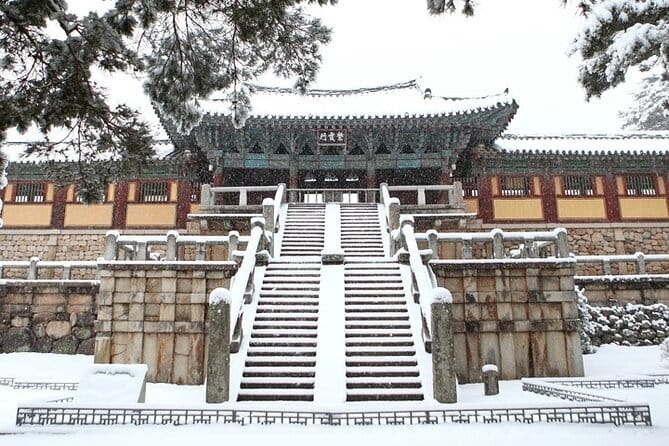
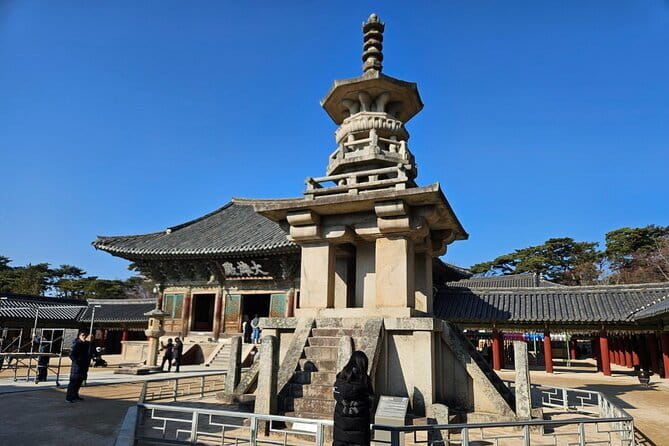
Bulguksa is the natural first choice for many people. Built during the Silla period, it represents the kingdom’s Buddhist culture and was created with hopes for peace and prosperity. The temple has undergone repeated restoration since 1920, but its importance comes from the surviving design, stonework, and national treasures connected with the site.
Plan about an hour here. You will walk through temple grounds and see why Bulguksa is often paired with nearby Seokguram Grotto as a UNESCO cultural site. The tour information describes admission here as free, while the general terms say attraction fees are not included. That difference is worth checking when you book, especially if you add places with paid entry.
Bulguksa is not a quick roadside photo stop. Give yourself time to look at the stairways, gates, courtyards, and wooded setting. In autumn, the temple is also a favored place for maple leaves. If you want a calmer visit, tell your guide that this matters more to you than squeezing in another short stop.
Royal tombs at Daereungwon and Cheonmachong
Central Gyeongju’s tomb district gives the city its unusual character. Large grass-covered burial mounds rise beside paths and city streets, reminders that Silla rulers and nobles were buried here between roughly the late fifth and early sixth centuries. The scale is easy to grasp on foot, and an hour at Daereungwon lets you walk among several tombs without needing a long explanation.
The excavations produced remarkable objects, including gold crowns, gold caps, waist belts, diadems, and gilt-bronze shoes. The gold crown associated with this group is described as the largest and most elaborate Korean example found in excavation. The experience is strongest when you treat the mounds as more than photo backgrounds and allow time for the museum displays or an open tomb.
Cheonmachong is the only tomb in the Daereungwon Ancient Tombs open to the public. Excavated in 1973, it measures about 12.7 meters high and 50 meters across. Its name comes from Cheonmado, a painting of a heavenly horse found on a mudguard saddle flap.
Allow about 30 minutes inside Cheonmachong. It adds scale and detail to the outdoor tomb walk, though visitors who dislike enclosed historical spaces may prefer to spend more time outside. The separate admission is listed as included for this stop, but you should still confirm the current arrangement because the general tour terms place attraction tickets outside the base price.
Cheomseongdae and the old royal center
Cheomseongdae Observatory is a short stop, usually about 30 minutes, but it gives you a useful look at Silla science. It is thought to date from the reign of Queen Seondeok, from 632 to 647, and is regarded as the oldest astronomical observatory in Asia.
The stone structure is compact, so you will not need a long visit. Its value is in the idea behind it: the Silla court watched the sky and used careful stone construction for scientific work. Pair it with the nearby royal tombs and you get a clearer picture of a capital city concerned with ceremony, burial, religion, and astronomy.
This is one of the stops most vulnerable to feeling rushed. If your group prefers detailed historical sites, ask your guide to give Cheomseongdae more than a quick photograph. If children or older family members are tiring, it is also an easy place to keep brief.
Same country, a completely different kind of day:
- Busan: Gyeongju Guided Day Trip to Three Kingdoms Capital
★ 4.8 · 1,925 reviews - Small Group Full Day Busan Tour (Max 6 Pax)
★ 5.0 · 1,464 reviews - Busan Private Tour with licensed tour guide + private vehicle
★ 5.0 · 1,143 reviews - Busan: Coastal Treasures Beach Train, Culture Village & More
★ 4.7 · 832 reviews
Donggung Palace and Wolji Pond after dark or by day
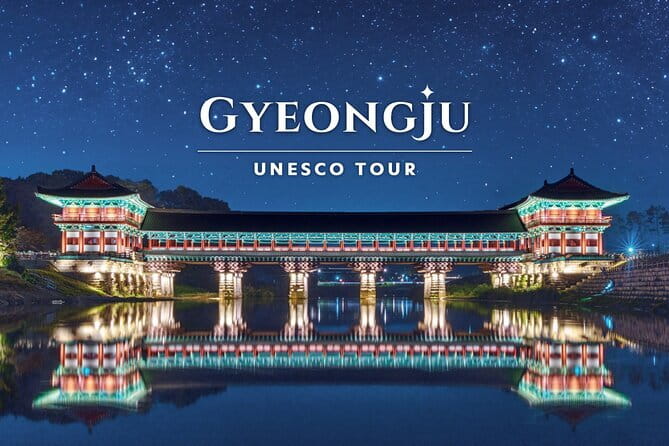
Donggung Palace and Wolji Pond was a secondary palace complex of Silla. The eastern palace served the prince, and royal banquets were held there for important events and guests. Today, the restored foundations and pond create one of Gyeongju’s most attractive historical settings.
The suggested visit is about an hour. The pond is particularly well suited to a slower walk, and the water helps you understand how royal architecture used reflections, gardens, and carefully placed buildings. The attraction has an admission fee, so include it in your budget.
The tour can visit many places in daylight, but the itinerary does not promise a particular arrival time. If seeing Wolji Pond in evening light is important to you, ask about the schedule before departure. Doing so may mean dropping another stop, since a full day from Busan already includes substantial driving.
Gyochon Village and Woljeonggyo Bridge
Gyeongju Gyochon Traditional Village offers a different view of Korean history. Instead of royal tombs and palace remains, you see hanok homes and the setting of the old Joseon period. The village includes Gyeongju Hyanggyo, a Confucian academy and shrine linked with Gukhak, Korea’s first state-operated educational institute, established in 682.
Allow about an hour. The visit is most useful for anyone who wants to understand how education, family life, and traditional homes fit into the story of Gyeongju. Some areas feel like a living neighborhood rather than a formal museum, so keep your voice low and respect any private spaces.
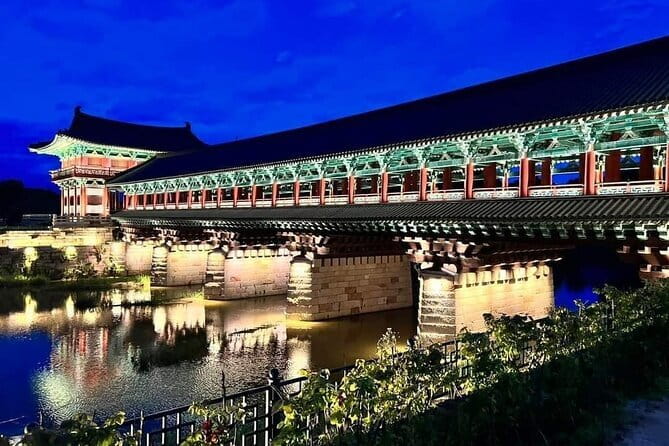
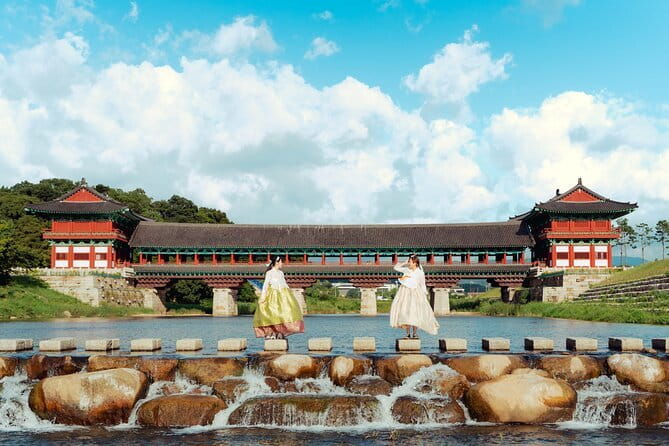
Nearby Woljeonggyo Bridge makes a good shorter stop. The original bridge dates to the Unified Silla period, from 676 to 935, but it later burned during the Joseon dynasty. It was rebuilt in April 2018 through historical research and is now described as Korea’s largest wooden bridge.
The schedule gives the bridge about 20 minutes in one place and an hour in another, so confirm how much time your guide recommends. The rebuilt structure is visually impressive, but it is not an ancient bridge in its present form. That distinction matters if you are looking for original remains rather than a historically informed reconstruction.
Hwangnidan-gil for lunch and a modern pause
Hwangnidan-gil is where the day shifts from archaeology to present-day Gyeongju. Restaurants, cafes, photo studios, and shops occupy hanok buildings along the street. Older buildings from the 1960s and 1970s add a newtro look, mixing worn façades with newer businesses.
The tour allows free time here for a meal, and that is a good use of the schedule. You can ask the guide to recommend Korean food that suits your taste. Since lunch is not included, decide in advance how much time and money you want to spend. A relaxed meal can be more satisfying than adding another ten-minute monument stop.
The drawback is that Hwangnidan-gil may feel more commercial than the temple or village sites. I would not choose it as the main reason to book the tour, but it provides a useful break and a chance to eat without adding another transfer. It also gives younger members of a mixed-age group something immediate and familiar to enjoy.
Yangdong Folk Village, the day’s rural counterpoint
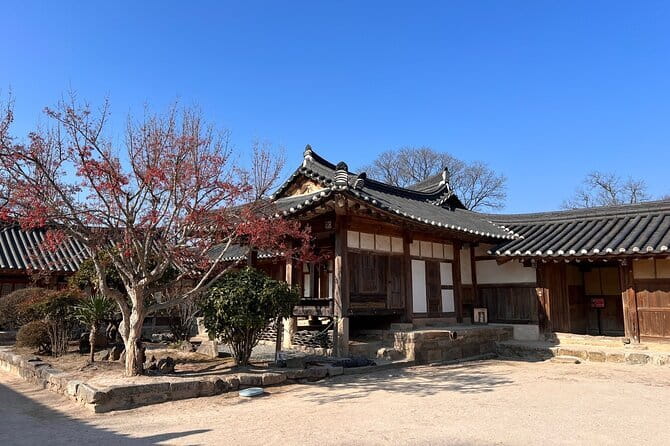
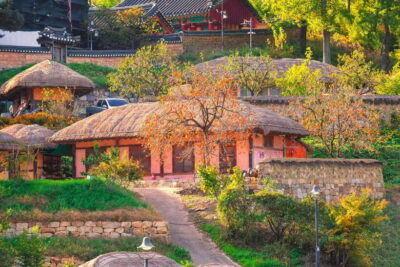
Yangdong Folk Village is the most distinctive addition to this private route. It is described as Korea’s largest traditional village, with about 160 old houses and 500-year-old thatched-roof cottages spread through a valley. Fifty-four homes are more than 200 years old and have been preserved in their original form.
The village shows Joseon-era traditions through its houses, family compounds, tiled roofs, thatched cottages, and position among four mountain spines beyond the settlement. Unlike a single reconstructed building, Yangdong gives you a whole village to walk through. That makes the visit feel broader and more grounded in daily life.
Plan about an hour, though you may want longer if traditional architecture is your main interest. The paths and slopes mean a moderate level of fitness is expected. Older relatives can still enjoy the visit, but ask the guide about the easiest route and allow time for rests.
Admission is not included. Since Yangdong lies outside the central Gyeongju group, adding it has a real time cost. I would choose Yangdong over several brief central stops if you care about traditional Korean homes and rural culture. If your priority is royal Silla sites, keep the village only if the schedule allows.
The village has received notable visitors, including King Charles III in 1993, but its real appeal is less about famous names than the preserved homes and quiet setting. You get a better sense of how Korean architecture responds to family structure, status, climate, and terrain.
How to build a sensible nine-hour route
The schedule lists roughly one hour each for Bulguksa, Daereungwon, the National Museum, Donggung and Wolji, Gyochon Village, and Yangdong Village, with shorter visits to Cheomseongdae, Hwangnidan-gil, Woljeonggyo Bridge, and Cheonmachong. Those times do not include driving.
That is too much for a comfortable day from Busan if you want to eat and listen to your guide. The practical target is about six site visits plus a meal stop. Here are three sensible ways to shape the day:
- Silla essentials: Bulguksa, Daereungwon, Cheonmachong, Cheomseongdae, Donggung and Wolji, plus lunch.
- Architecture and village life: Bulguksa, Gyochon Village, Woljeonggyo Bridge, Hwangnidan-gil, and Yangdong Village.
- Broad first visit: Bulguksa, Daereungwon, Cheonmachong, Cheomseongdae, Hwangnidan-gil, and Yangdong Village.
The Gyeongju National Museum is also available as an approximately one-hour stop, though its specific exhibits and admission details are not provided here. Add it if objects and archaeology matter more to you than walking through another outdoor site.
Be clear about your priorities before the car leaves. The tour’s great strength is choice, but too much choice can produce a checklist day. A good guide can help you cut stops without making the day feel incomplete.
What the $430 price really buys
The $430 price covers a private group of up to eight, not eight separate tickets. It includes the air-conditioned vehicle, licensed driving guide, fuel, parking, tolls, pickup and drop-off at preferred places, fees, and taxes.
For a full group, that is a reasonable way to handle a complicated day. You also gain control over the pace and avoid splitting up a family. For a couple, the cost is harder to justify unless convenience and private planning are more important than saving money.
Set aside extra money for lunch, personal purchases, and attraction admissions. The information gives mixed details for individual sites, with Bulguksa described as free, some places showing included admission, and the general terms excluding attraction fees. Ask for a current ticket estimate before the day begins.
Free cancellation is available if you cancel at least 24 hours before the start time. Late cancellations or changes are not accepted, and confirmation is subject to availability.
Who should book this private Gyeongju tour
I would recommend it most strongly to families, groups of friends, and anyone staying in Busan who wants a full Gyeongju day without public transportation. It is also a good fit if older relatives or young children need a vehicle, flexible stops, and help at each attraction.
History fans should book only after choosing priorities. You will not get a leisurely museum day, a long temple retreat, and a full Yangdong walk in the same nine-hour outing unless you accept a very late or rushed schedule.
I would skip it if you are a solo budget traveler, prefer slow independent exploration, or want to spend a full day at just one or two sites. In those cases, the private group price may buy more convenience than you need.
FAQ
How long does the tour last?
The experience is described as approximately nine hours. The customizable itinerary also refers to a ten-hour private tour, so you should confirm the exact schedule when booking.
Can I start the tour in Busan or Gyeongju?
Yes. Departure can be from Busan or Gyeongju, and the tour offers pickup and drop-off at preferred places.
How many people can join the private vehicle?
The price is for one private group of up to eight people.
Are meals included?
No. Lunch and other meals are not included. You can have free time for a meal at Hwangnidan-gil, and the guide can recommend Korean food to suit your preferences.
Are attraction entrance fees included?
The general terms say attraction entrance fees are not included. Individual stop details show different admission arrangements, so confirm the current fees for the sites you select.
What fitness level is needed?
A moderate level of physical fitness is advised. Yangdong Folk Village includes walking through a traditional village with slopes and uneven areas, so ask your guide about pacing if someone in your group has limited mobility.
Should you book it?
Book this tour if you want to connect Gyeongju’s major sites in one day and value a private car more than the lowest possible price. I would make Yangdong Village, Bulguksa, Daereungwon, and either Donggung and Wolji or Gyochon Village the core of the plan, then fit in lunch at Hwangnidan-gil.
The best result will come from choosing six meaningful stops, not chasing every name on the list. With a full vehicle, a clear priority list, and a guide such as Park Jin Hyouck, Ted, or Kei, this is a practical way to see Gyeongju’s Silla monuments and Joseon-era village life in one well-planned day.
More Full-Day in Busan
- Authentic Busan Full-Day City Highlights Tour
★ 5.0 · 272 reviews - Full-Day Tour Unmissable things to do in Busan
★ 5.0 · 195 reviews - Full Day Busan Tour Including Haedong Yonggungsa Temple
★ 4.5 · 71 reviews - Full Day Private Busan Highlight Tour with Licensed Guide
★ 5.0 · 52 reviews
More Private Car with Driver in Busan
- Busan: Private Car Charter Customized City Tour
★ 4.8 · 96 reviews - BTS Landmarks Private Car Tour in Busan with a Licensed Guide
★ 5.0 · 10 reviews - Jeju Island Popular Sightseeing Private Car Charter Tour 5/9hours
★ 5.0 · 382 reviews - Jeju Island: Private Car Charter Tour
★ 4.9 · 157 reviews
Just added around Busan
- Real Busan Walking Experience★ 5.0 · 27 reviews
- 7 Highlights Gyeongju City One Day Small Group Tour from Busan★ 5.0 · 24 reviews
- Suncheon and Yeosu Daily Private Tour with Pickup Service★ 5.0 · 3 reviews
- Visit Busan night market and enjoy the night view of Busan harbor★ 5.0 · 6 reviews
- Busan Highlights Shore Tour – Cruise Return Assured★ 4.5 · 34 reviews
- Suncheon one day tour from Seoul, Busan or Suncheon★ 5.0 · 3 reviews
- Busan Beomeosa Temple & Hongbeopsa Temple with temple lunch★ 5.0 · 11 reviews
- Busan Seafood Tour : Oyster village Tour with Oyster cuisines★ 5.0 · 3 reviews
UNESCO World Heritage Tours, compared.
Gyeongju UNESCO World Heritage Guided Day Tour
Read our review →
East Jeju Essentials – Seongsan Ilchulbong (UNESCO) & Haenyeo
Read our review →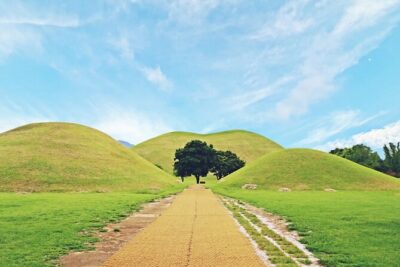
Gyeongju UNESCO World Heritage Guided Day Tour from Busan
Read our review →
Jeju Southern UNESCO Full Day Tour with Mt.Halla
Read our review →
Jeju island Southern UNESCO Day Tour With Hallasan MT
Read our review →Browse the lists this tour appears in