
Reviewed · WORKSHOPS
Busan Kkakdugi(Korean radish Kimchi) class with various options
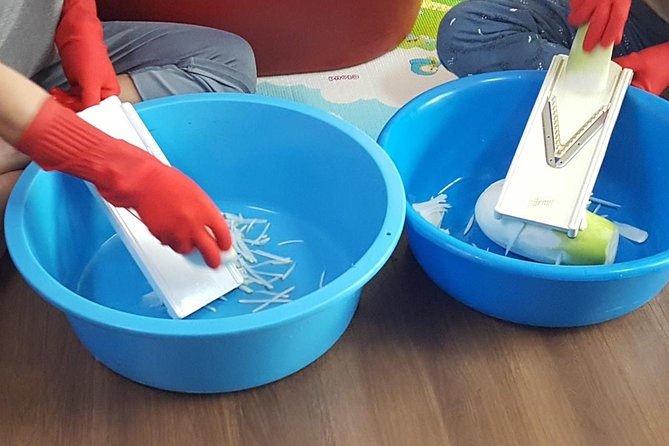
The best part of this Busan experience is that you do not simply watch someone make kimchi. You salt the radish, mix the seasoning, wait for the right texture, and finish your own batch. Paul leads the class in clear English, and the recipe is simple enough to repeat at home.
I like the small-group setting and the useful take-home container. I also like the pause for Korean Chinese lunch while the radish marinates, since it turns a waiting period into part of the cultural experience. The main drawback is that the class takes about three and a half hours and does not include a market visit, so it may feel slow if you want a fast cooking demonstration.
Key points to know before booking
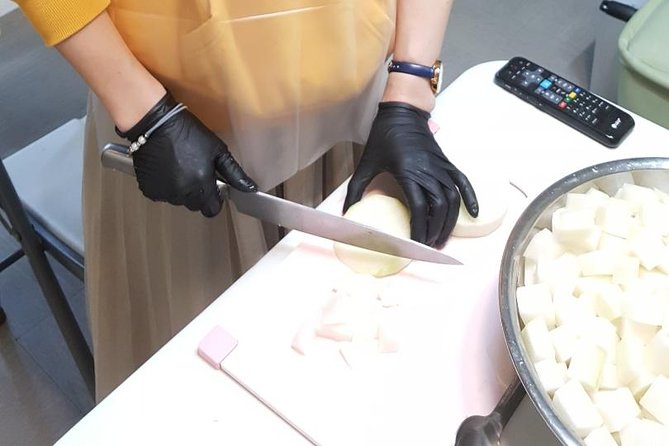
- You make kkakdugi by hand: The class focuses on Korean radish kimchi, with step-by-step guidance for first-time cooks.
- Paul teaches in English: He explains the process and shares Korean food culture throughout the session.
- Lunch fills the marinating break: You eat at a Korean Chinese restaurant while the radish sits in salt.
- You take kimchi home: A plastic container is provided for your finished radish kimchi.
- The spice level can be adjusted: One class member found the full chili mixture too hot, and the amount was reduced.
- The class ends with beach photos: After cooking, Paul takes the group to a nearby beach for pictures.
Making Busan-style kkakdugi in a home kitchen
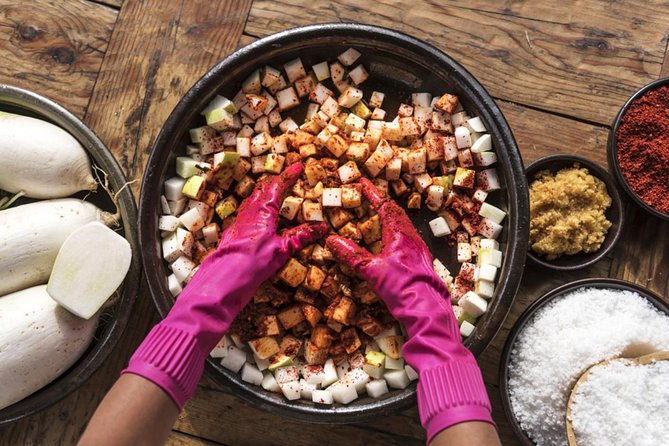
Kkakdugi is the cubed-radish version of kimchi. Instead of leafy napa cabbage, you work with Korean radish cut into chunky pieces, then coat it in a red seasoning mixture. The result is crisp, spicy, salty, and slightly sour as it ferments.
This class keeps the method straightforward. That matters because kimchi lessons can become complicated when they cover many vegetables, several fermentation styles, or a long list of hard-to-find ingredients. Here, the focus stays on one dish and on a recipe you can use again in your own kitchen.
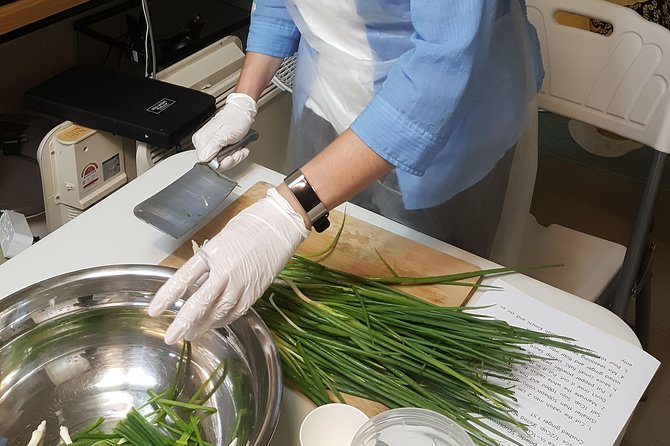
You begin at the meeting point near Seomyeon subway station, at 730 Jungang-daero in Busanjin District. From there, you move to the instructor’s kitchen. The class starts with an explanation of how radish kimchi is made, followed by the first practical task: preparing the radish for salting.
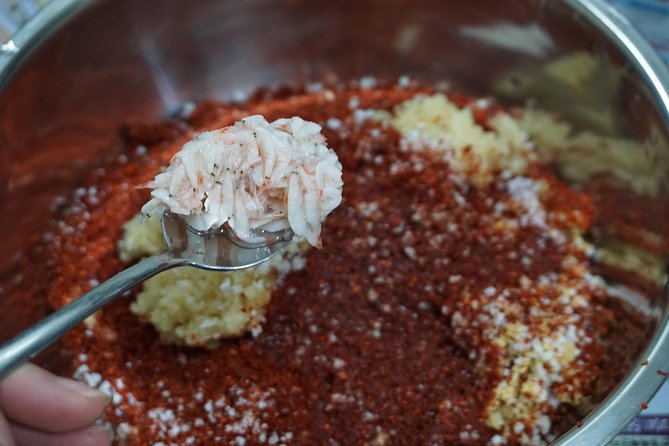
The radish needs roughly two hours to marinate with salt. This is not a cooking error or a dead stretch in the schedule. Salting pulls out moisture and helps give kkakdugi its firm bite. If you rush this part, the finished kimchi can lack the texture that makes it satisfying.
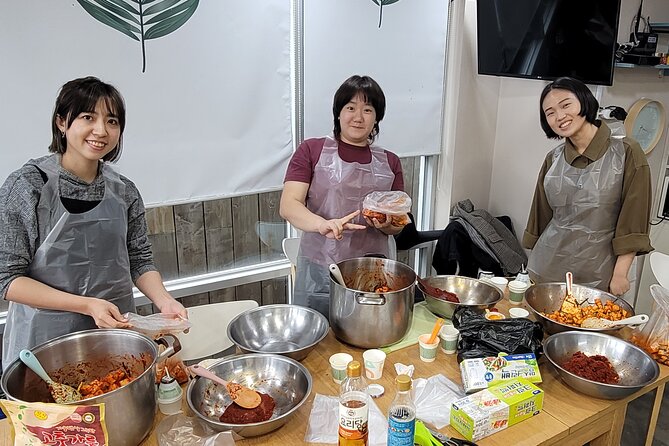
While the radish rests, you make the seasoning sauce. The instructor prepares enough sauce to give participants extra for another batch at home. That small detail adds real value to the lesson. You leave with more than a container of finished kimchi and a memory of the class. You also have a chance to repeat the process later.
The method is designed for beginners. You get simple instructions and step-by-step help rather than being expected to know Korean cooking terms or techniques. The class is hands-on, but it does not demand advanced knife skills or previous kimchi experience.
A few more Busan trips to weigh up
- Korean cooking class in Haeundae, Busan
★ 5.0 · 92 reviews - Busan Tailored Korean cooking class (Vegan OK)with market tour
★ 5.0 · 66 reviews - Busan: Small-Group Traditional Korean Food Cooking Class
★ 4.9 · 58 reviews
Lunch during the two-hour marinating break
The waiting period includes lunch at a Korean Chinese restaurant. Korean Chinese food is its own style, shaped by Chinese cooking but adapted to Korean tastes. The meal gives you a chance to sit down, eat, and continue talking with Paul while the radish takes on salt.
This is one of the more useful choices in the schedule. A two-hour marinating period would be awkward if you simply had to wait in the kitchen. Lunch makes the timing practical and adds another food experience to the price.
One dish specifically mentioned from the class is spicy mixed noodles with sea snail. You should expect the meal to be part of the local food introduction, not a separate restaurant tour or a free period to choose your own restaurant. Coffee or tea is also included.
The lunch stop may be especially welcome after a morning of sightseeing around Busan. It breaks up the class and gives you a relaxed setting to ask questions. If you are hoping for a market lunch or a meal built around the radish itself, keep your expectations in check. The included meal is Korean Chinese, and the class does not include a market tour.
Finishing the kimchi after the radish rests
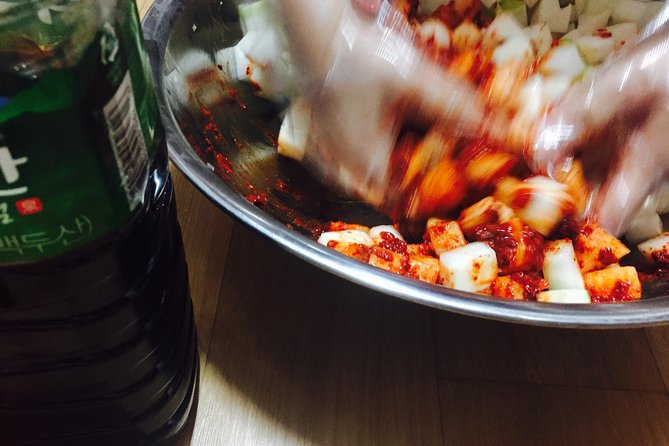
After lunch, you return to the kimchi process. The radish should now be properly marinated, and you finish the dish by combining it with the seasoning sauce. This is the point when the class becomes especially useful: you can see how the texture changes and how much sauce is needed to coat the cubes.
The instructor provides a plastic food container for your portion of radish kimchi. The amount can be substantial. One class participant reported making 5 kilograms of kkakdugi with Paul, then packing it all into a container to take home. The exact quantity for each booking is not separately stated, so you should treat that amount as a useful indication rather than a guaranteed serving size.
The class also gives you extra seasoning sauce for future use. That makes the experience more practical than a one-time food craft. You can use what you learn to make another batch later, though you will need your own radishes and ingredients at home.
Spice deserves attention. A full amount of chili paste was too strong for one participant, so the mixture was cut in half. This is a good reminder to speak up about your tolerance. Kkakdugi can be hot, and the recipe appears flexible enough to adjust. If you prefer milder food, tell Paul before the sauce is fully mixed.
Paul’s teaching style and the small-group feel
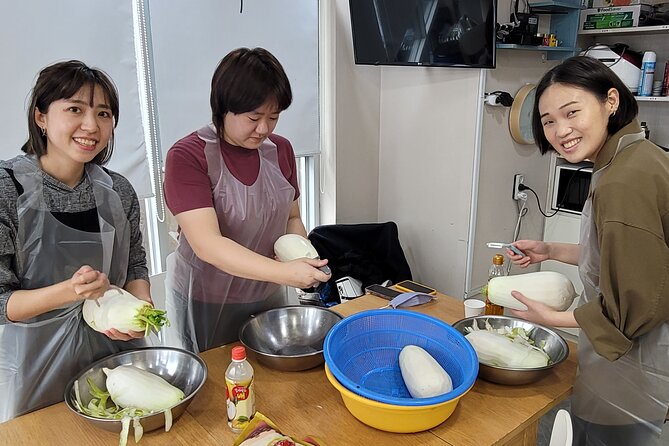
Paul is the named instructor for this experience. He teaches in English and explains both the recipe and the cultural background behind it. His approach is enthusiastic and personal, with plenty of room for direct participation.
The advertised group size is small, with a stated maximum of six in the highlights and a maximum of eight in the additional details. Because those numbers differ, I would confirm the expected group size when booking. Either way, this is intended to be a small class rather than a large demonstration.
A smaller group changes the experience in useful ways. You can ask questions without waiting for a crowd to move along. You also get more direct help when salting the radish, mixing the sauce, and packing the finished kimchi.
The setting is a private kitchen rather than a formal cooking school. That can feel more personal and less polished. You should expect a practical home-style lesson, not a staged culinary show with professional equipment or a long printed curriculum.
The available feedback is strongly positive, with a 5 out of 5 rating from six reviews. The praise centers on Paul’s friendly manner, clear English, cultural explanations, enjoyable lunch, and the ease of making the kimchi. Those are the features I would give the most weight to when deciding if this class fits your trip.
Same country, a completely different kind of day:
- Busan: Gyeongju Guided Day Trip to Three Kingdoms Capital
★ 4.8 · 1,925 reviews - Small Group Full Day Busan Tour (Max 6 Pax)
★ 5.0 · 1,464 reviews - From Busan: Gyeongju UNESCO World Heritage Guided Day Tour
★ 4.8 · 1,250 reviews - Busan Private Tour with licensed tour guide + private vehicle
★ 5.0 · 1,143 reviews
The beach photo stop after cooking
Once the food work is finished, Paul takes the group to a nearby beach for photographs. This gives the class a natural ending and adds a small Busan sightseeing element.
The beach visit is not described as a guided coastal walk or a long sightseeing stop. Think of it as a photo opportunity after the cooking session. That is useful if you want a few pictures connected to the experience, but it should not replace a dedicated beach tour in your plans.
The nearby location also helps keep the activity within its roughly three-and-a-half-hour schedule. You start near Seomyeon, move to the kitchen, go out for lunch, return to complete the kimchi, and finish with the beach stop before ending back at the meeting point.
Since the experience requires good weather, the outdoor portion matters to the schedule. If poor weather forces a cancellation, you are offered another date or a full refund. The provider may also cancel if the minimum number of people is not reached, with the same choice of a different date, another experience, or a full refund.
What the $100 price includes
The cost is $100 per person. That is not a bargain if you judge the class only as a cooking lesson. It becomes more reasonable when you count the meal, tea or coffee, the finished radish kimchi, the container, extra seasoning sauce, the small-group instruction, and the beach photo stop.
You are paying for several hours of guided time and for ingredients that would otherwise be difficult to measure or purchase during a short visit. You also get an experience connected to Korean food culture rather than a standard restaurant meal.
The value is strongest for you if you want to bring home something you made yourself. The container solves a practical problem. You do not need to find a jar or food box in Busan, and you can carry the kimchi onward during your trip.
The price is less appealing if you mainly want to sample kimchi, take a quick class, or visit a traditional market. The market tour is specifically not included, and the activity lasts long enough that it uses a meaningful part of your day.
Group discounts are available, which may improve the value for families or friends booking together. The ticket is mobile, so you do not need a printed voucher. Confirmation is sent within 48 hours, subject to availability, so do not leave the booking until the final day of your trip.
Who will enjoy this class most
I would recommend the experience to food-focused visitors, first-time cooks, and anyone who wants a hands-on introduction to Korean home cooking. It is also a good choice for people who enjoy meeting a local instructor and asking questions rather than moving through a fixed sightseeing route.
The class suits you if you are happy to spend time on one dish. Kkakdugi is the entire cooking focus, so do not book it expecting to learn bulgogi, mandu, japchae, or several kinds of kimchi.
It may also work well for families and small groups, provided everyone is comfortable with spicy food and a few hours of cooking. The group discounts may help with the cost, and the shared lunch gives the experience a social rhythm.
You may want to skip it if you have limited time in Busan, dislike spicy food, or want a market-based food tour. It is also not the right choice if you prefer to avoid activities with a fixed non-refundable booking policy.
Practical details that affect your day
The meeting point is at Seomyeon, near public transportation, at 730 Jungang-daero in Busanjin District. The activity ends back at the meeting point, although the class includes movement between the station, the kitchen, the restaurant, and the beach.
Plan for about three hours and thirty minutes. The schedule is shaped by the radish’s two-hour salt marinade, so you cannot compress the class into a quick demonstration. Allow enough time afterward for your own plans, especially if you have a timed reservation.
The cooking class does not include a market tour. Private expenses and travel insurance are also excluded. Lunch, coffee or tea, radish kimchi, and the plastic food container are included.
The experience is non-refundable and cannot be changed after booking for any reason. That makes weather-related protection important, but it does not cover a personal change of plans. Check your schedule carefully before committing.
A few useful tips for the cooking session
Tell Paul early if you prefer a mild spice level. The seasoning can be adjusted, and one batch needed half the chili mixture for a more comfortable heat.
Wear clothes and shoes that you do not mind using around food preparation. The supplied information does not specify an apron or protective clothing, so do not assume those items will be provided.
Bring a plan for carrying the container after class. The kimchi will be packed for you, but the experience does not state the container’s size or how long it can be stored without refrigeration. If you are leaving Busan immediately, ask about handling it during the rest of your trip.
Keep the extra seasoning sauce in mind when planning your luggage. It is a useful part of the class, but it may add another container to carry.
Most of all, take notes or photos of the process if you want to repeat it. The recipe is meant to be simple, and the extra sauce helps, but remembering the order of salting, marinating, seasoning, and packing will make your next batch easier.
Should you book the Busan kkakdugi class?
Book it if you want a personal, hands-on food experience with a local English-speaking instructor, a proper meal, and something edible to take home. The strongest reasons are Paul’s friendly teaching, the manageable recipe, the small group, and the chance to make a large batch rather than merely taste a sample.
Think twice if your priority is a market visit, a short activity, or a broad survey of Korean cooking. The $100 price is fair for the full package, but only if you value the meal, ingredients, instruction, take-home kimchi, and beach photographs together.
For many visitors, this is a good way to spend half a day in Busan because it connects cooking with conversation and local food customs. Just confirm the group size, plan for the full three-and-a-half-hour schedule, and be clear about your preferred spice level before you book.
FAQ
Where does the Busan kkakdugi class meet?
The meeting point is near Seomyeon subway station at 730 Jungang-daero, Busanjin District, Busan, South Korea.
How long does the experience last?
The activity lasts approximately three hours and thirty minutes.
What kind of kimchi will I make?
You will make kkakdugi, a Korean radish kimchi made with cubed radish and seasoning sauce.
Is lunch included?
Yes. Lunch at a Korean Chinese restaurant is included, along with coffee or tea.
Can I take the kimchi home?
Yes. A plastic food container is provided for your radish kimchi.
Does the class include a market tour?
No. The local market tour is not included.
What happens after the cooking class?
After the class, the instructor takes the group to a nearby beach for photographs. The activity then ends back at the meeting point.
What happens if bad weather cancels the activity?
If poor weather causes a cancellation, you are offered a different date or a full refund. If the minimum number of participants is not reached, you are offered a different date or experience, or a full refund.
Just added around Busan
- Real Busan Walking Experience★ 5.0 · 27 reviews
- Full Day Private car tour to UNESCO Gyeongju&Yangdong village★ 5.0 · 5 reviews
- 7 Highlights Gyeongju City One Day Small Group Tour from Busan★ 5.0 · 24 reviews
- Suncheon and Yeosu Daily Private Tour with Pickup Service★ 5.0 · 3 reviews
- Visit Busan night market and enjoy the night view of Busan harbor★ 5.0 · 6 reviews
- Busan Highlights Shore Tour – Cruise Return Assured★ 4.5 · 34 reviews
- Suncheon one day tour from Seoul, Busan or Suncheon★ 5.0 · 3 reviews
- Busan Beomeosa Temple & Hongbeopsa Temple with temple lunch★ 5.0 · 11 reviews
Workshops, compared.
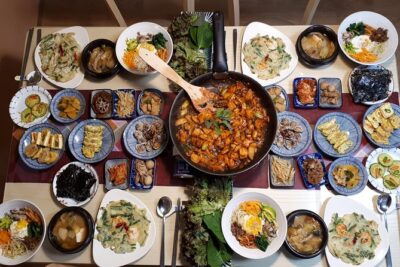
Local Home Korean Cooking Class & Market Adventure in Seoul
Read our review →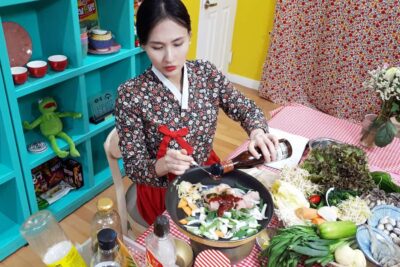
Korean Cooking Class at a Local Home and Market Tour
Read our review →
Yongpyong Ski Resort from Seoul with Optional Lesson and Packages
Read our review →
Korean Cooking Class with Grocery Shopping at Seoul Local Market
Read our review →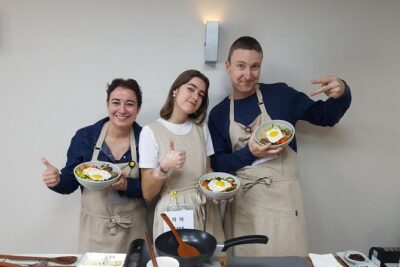
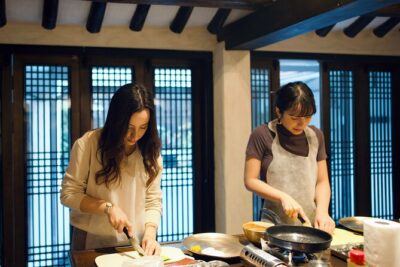
Royal Seoul Cooking Class in a 100-Year-Old Hanok
Read our review →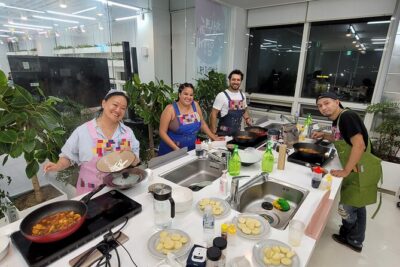
Busan Tailored Korean cooking class (Vegan OK)with market tour
Read our review →
Taste of Korea, Authentic Home-Style Cooking Class
Read our review →Browse the lists this tour appears in