
Reviewed · HISTORICAL TOURS
Discover Seoul: Local Life and History
Seoul’s best introduction may be a walk from Seoul City Hall to Bukchon Hanok Village, where broad modern avenues give way to palace gates, Confucian-era stories, tea rooms, and steep lanes lined with traditional homes. I like the clear old-to-new progression, and I like that guides such as Moises and Gemma add practical food and drink advice, including Korean beer chicken and local tea houses. The main drawback is the pace: three and a half hours is enough for an overview, not a leisurely visit inside every major site.
I also like the route’s useful starting point for a first day in Seoul. You get history, orientation, and neighborhood advice in one walk, with no complicated transport between stops. The 20-person maximum keeps the group from becoming enormous, though Bukchon’s hills and uneven lanes can still make this tiring in hot, wet, or cold weather.
Key points at a glance
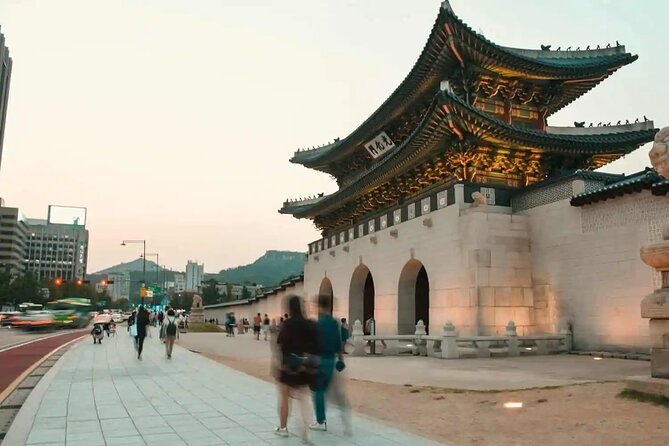
- A strong first walk: Follow Seoul’s story from City Hall and Gwanghwamun Square into palace grounds and old residential lanes.
- Six connected stops: The route includes City Hall, Gwanghwamun Square, the King Sejong and Admiral Yi Sun-sin statues, Gyeongbokgung Palace, Insadong, and Bukchon Hanok Village.
- Useful local advice: Guides provide suggestions for Korean food, bars, tea houses, and places to continue exploring after the tour.
- History with recognizable landmarks: Stories about King Sejong, Admiral Yi Sun-sin, and the Joseon dynasty give meaning to the monuments and palace gates.
- A compact walking format: The tour lasts about 3 hours 30 minutes and finishes near Cafe Onion Anguk, in the Bukchon area.
- Good value for orientation: At $96.75 per person, the price makes most sense if you want a guided overview early in your Seoul visit.
Why this route works for a first look at Seoul
Seoul can feel vast at first. One minute you are beside a glass office tower or a broad traffic avenue, and the next you are in a narrow lane with tiled roofs and wooden fronts. This tour makes that contrast the main story rather than treating old Seoul and modern Seoul as separate attractions.
The walk covers the Gwanghwamun and Jongno-gu areas, two central districts where royal, religious, civic, and commercial life have long overlapped. You begin at Seoul Plaza, move along Gwanghwamun Avenue, pause at major national symbols, then reach the palace and older neighborhoods beyond it.
That sequence matters. You are not simply checking off six sights. You are building a mental map. By the time you reach Bukchon, you should have a better sense of how Seoul’s Joseon-era center fits beside the modern capital.
The tour is especially useful early in a stay because the guides offer advice about eating and drinking. Moises received especially strong praise for clear English, historical explanations, and help finding authentic Korean street food. Gemma was also singled out for bringing the city’s past to life while explaining its present-day character. Guide assignments can vary, so book this for the route and format rather than expecting one particular person.
A few more Seoul trips to weigh up
- Seoul: Evening Dark History, Folklore & Ghost Story Walking Tour
★ 5.0 · 593 reviews - Hanbok Photoshoot and History Tour at Gyeongbokgung Palace
★ 5.0 · 276 reviews - From Seoul: Dae Jang Geum Park Historic K-Drama Set Tour
★ 4.9 · 143 reviews
Seoul City Hall and the first 30 minutes
The walk begins at Seoul Plaza, outside Seoul City Hall on Sejong-daero. The opening half hour serves as a civic and historical introduction before the tour heads toward the palace district.
City Hall is a sensible meeting point. It is central, easy to identify, and close to public transportation. It also gives the guide room to explain how Seoul developed as a capital and how its modern government center relates to the older royal core.
Do not expect a long building tour here. The stop is listed as about 30 minutes, with no admission charge, and the main value is the explanation of the setting. If you have just arrived in Seoul, this opening can help you place the city’s major districts before the walking becomes more focused on Joseon-era sites.
The tour operates Monday through Friday between 10:00 a.m. and 5:00 p.m. The information also notes that City Hall may be closed on some Tuesdays, so check the exact schedule before you set out. A mobile ticket is provided, and confirmation arrives when you book.
Gwanghwamun Square and Seoul’s public memory
From City Hall, the route continues to Gwanghwamun Avenue and Gwanghwamun Square. The planned visit lasts about 35 minutes, making this one of the longer stops before the palace.
The square is a wide public space in front of Gwanghwamun Gate. It is not just a photo stop. The guide uses the avenue and its monuments to explain important figures and periods in Korean history, helping you read the space as a national stage.
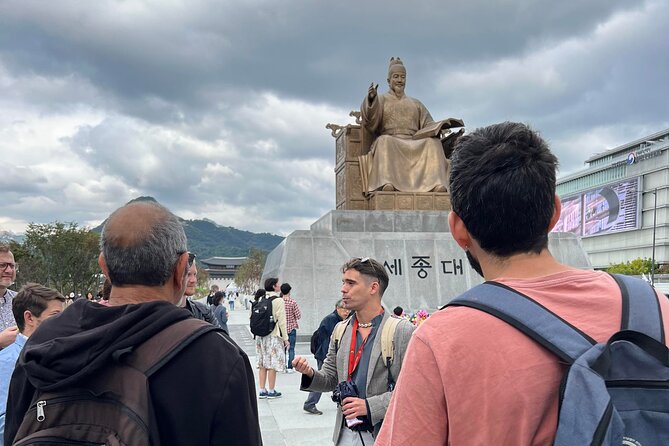
The next stop focuses on two statues: King Sejong the Great and Admiral Yi Sun-sin. King Sejong is closely associated with the creation of Hangul, the Korean alphabet, while Admiral Yi Sun-sin is remembered as a major naval commander of the Joseon dynasty. The tour allocates about 10 minutes here.
That is a short pause, but it can be one of the most useful parts for first-time visitors. These are not obscure historical figures hidden in a museum. Their statues sit in one of Seoul’s most visible public spaces, and the stories help explain why Korean history remains so present in the city.
Expect open space and city traffic here, not a quiet old quarter. That contrast is part of the point. The route shows you a modern capital using public monuments to keep older national stories in daily view.
Gyeongbokgung Palace and the guard change
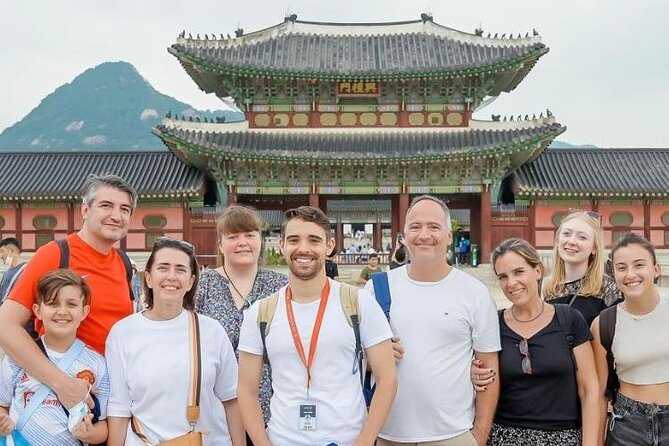
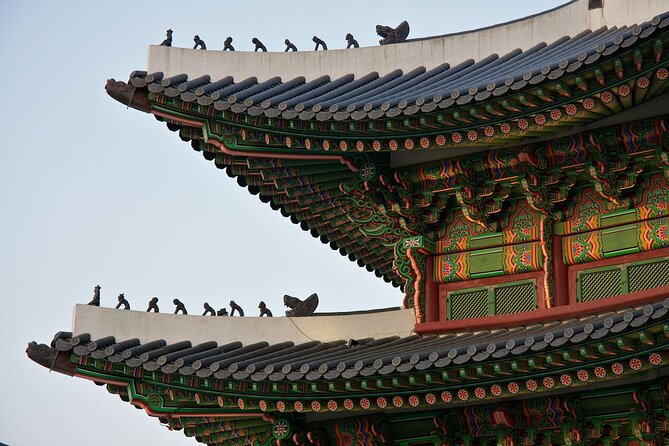
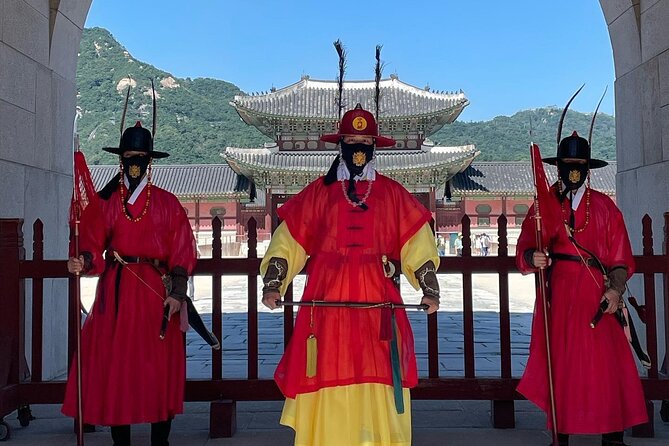
Gyeongbokgung is the central attraction on this walk. It was the main royal palace of Seoul, and the tour gives you an introduction to the complex and its role in the Joseon dynasty.
The planned stop lasts about 30 minutes and includes the change of the guards. Timing matters here. A guard ceremony is tied to a schedule, and the tour description does not give a precise ceremony time, so you should confirm the day’s arrangement rather than assume the change will happen exactly when you arrive.
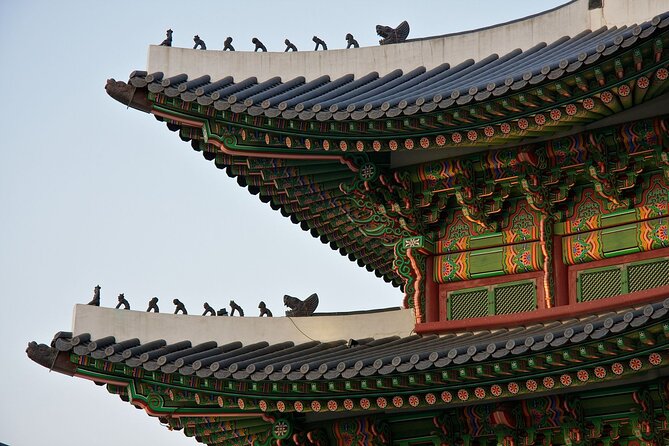
The palace portion is designed as an introduction, not a full architectural study. You will hear how the royal center fits into Seoul’s older plan and see the setting that makes the city’s shift from palace district to modern capital easier to understand. If you want to inspect halls, courtyards, gardens, and museums at a slow pace, plan a separate return visit.
One practical point deserves attention: each itinerary stop is listed with free admission, including Gyeongbokgung. Because palace admission arrangements can change and the tour description does not explain whether any access is covered separately, confirm what your mobile ticket includes before booking. The stated price is $96.75 per person, so you should know if you are paying mainly for guiding and orientation or also for entry services.
Even with that question, the palace is where the tour’s theme comes together. Modern Seoul surrounds the old royal center, but the gates, courtyards, and ceremonial traditions make the Joseon capital easy to picture.
Same country, a completely different kind of day:
- Best DMZ Tour Korea from Seoul (Red Suspension Bridge Optional)
★ 5.0 · 41,422 reviews - DMZ Tour: 3rd Tunnel, Option(Suspension Bridge, Boat) from Seoul
★ 5.0 · 21,373 reviews - DMZ tour south Korea from Seoul (NK experience hall, defector)
★ 5.0 · 20,599 reviews - Seoul: DMZ Tour with Optional Suspension Bridge
★ 4.8 · 5,277 reviews
Insadong’s tea houses, galleries, and craft shops
After Gyeongbokgung, the route turns into Insadong, one of Seoul’s oldest neighborhoods. The scheduled visit lasts about 30 minutes and shifts the mood from formal royal spaces to narrow commercial lanes.
Insadong is known here for traditional tea houses, galleries, bars, craft shops, and Hanok buildings. The attraction is not one grand monument. It is the chance to see how older architectural forms and traditional arts remain part of an active neighborhood.
This is also where a good guide can add real value. Moises was praised for taking the group to a memorable tea house, and that kind of stop can be more useful than another quick photo. A tea house gives you a pause, a taste of local custom, and a way to understand why Insadong remains associated with traditional culture.
The route is still moving at a steady pace, though. Thirty minutes will let you look around and gather ideas, but it will not support a long gallery visit, a slow shopping session, and a full tea service all at once. I would treat the tour as a preview. If a shop, gallery, or tea house catches your attention, note it and return later.
The food advice is another benefit. Guides point you toward Korean dishes and places to eat, including Korean beer chicken. That makes the tour more than a history walk. You finish with suggestions you can use that same evening.
Bukchon Hanok Village and the final climb
The last major stop is Bukchon Hanok Village, reached after the palace and Insadong. The tour describes Bukchon as a traditional village on a hill between Gyeongbokgung and another royal palace area, with a 600-year-old setting of Hanok homes and narrow alleys.
Bukchon is visually different from the broad spaces earlier in the route. The lanes are tighter, the streets rise and fall, and the traditional homes make the neighborhood feel residential rather than ceremonial. You get a sense of how older Korean housing survives within a large modern city.
The scheduled visit lasts about 30 minutes. That is enough for an introduction and some views, but not a full exploration of the village. Because Bukchon is hilly, wear comfortable shoes and expect the final section to require more effort than the flat opening near City Hall. The tour description does not promise a slow pace or rest breaks.
There is also a useful distinction here. Bukchon is not simply an open-air museum. It is a living neighborhood, so you should keep voices low, avoid blocking narrow lanes, and respect private homes. The guide can help you understand the area, but the short stop means you may want to return independently if you hope to explore more carefully.
The walk ends near Cafe Onion Anguk on Gyedong-gil, in the Bukchon area. This is a practical finish because you are already positioned for more time around Anguk and Jongno, though the tour does not include a meal or extended cafe visit.
What the guides add to the walk
The strongest part of this experience is likely to be the person leading it. The route itself includes famous Seoul sights that you can reach on your own. The guide’s job is to connect them, explain the people behind the monuments, and make the neighborhood choices easier.
Moises is noted for excellent English, clear cultural and historical explanations, and good food recommendations. He also continued to make the walk worthwhile in rainy weather, which suggests a practical, adaptable approach. Gemma is described as bringing the country’s past into focus while also pointing out modern Seoul.
You should still keep expectations sensible. Guide quality can vary by assignment, and the information does not guarantee that Moises or Gemma will lead your date. The most reliable reasons to book are the compact route, the small maximum group size, and the combination of history with local suggestions.
A maximum of 20 people is not an intimate private walk, but it is manageable. You can expect a shared group experience rather than a custom itinerary. If you want detailed photography time, a private palace lesson, or a food-focused outing, this will probably feel too broad.
Price, length, and practical value
At $96.75 per person, this is not a budget stroll. Seoul offers many public areas and monuments that you can visit without paying for a guide, and the listed stops do not carry separate admission charges in the itinerary. The price needs to earn its keep through explanation, route planning, language help, and local advice.
I think it can be worthwhile for a first visit, especially if you have only a short stay or a Seoul layover. One strong review came from someone using an Incheon Airport layover, and the compact duration makes this kind of sightseeing possible for someone with limited time, provided the airport and transport schedule leave enough margin. The tour itself lasts about 3 hours 30 minutes, so it is not a quick stop between flights.
The tour also makes more sense at the beginning of your visit. You receive tips on food, tea, bars, and neighborhoods before you make your own plans. If you already know Seoul well, the price may feel high for a route that moves quickly through familiar landmarks.
The experience requires good weather, and it may be canceled if the minimum number of participants is not met. In either case, you are offered another date or a full refund. You can cancel for a full refund up to 24 hours before the start time, but changes or cancellations inside that window are not accepted.
Who should book this Seoul walking tour?
I would choose this tour if you want a guided first look at central Seoul, prefer history explained in plain English, and like mixing major landmarks with smaller neighborhood details. It suits couples, solo visitors, and families who can manage several hours on foot and some uphill walking.
It is also a good match for anyone who wants help deciding what to eat and where to return later. The tea house advice and Korean food suggestions give the tour a practical afterlife once the walk ends.
I would hesitate if you want long interior visits, extensive shopping time, or a private pace. The route covers six stops in a little over three hours, so each place receives an introduction rather than a full visit. Rain can also make the palace grounds and Bukchon’s slopes less comfortable, even though a guide can still keep the historical portion engaging.
Should you book Discover Seoul: Local Life and History?
Book it if you want Seoul explained through a connected walk rather than a string of isolated sights. The route from Seoul Plaza to Gwanghwamun, Gyeongbokgung, Insadong, and Bukchon gives you a clear first-day framework, while the guides add food, tea, and neighborhood advice that a map cannot provide.
Skip it if you already have a detailed Seoul plan and would rather spend the $96.75 on independent visits or meals. For a first-time visitor, a short-stay visitor, or someone who values a strong English-speaking guide, it offers useful orientation in one well-packed morning or afternoon.
FAQ
How long does the Seoul walking tour last?
The tour lasts approximately 3 hours and 30 minutes.
How much does the experience cost?
The listed price is $96.75 per person.
Where does the tour begin?
The meeting point is Seoul Plaza, at 110 Sejong-daero in Jung District, Seoul.
Where does the tour finish?
The walk finishes in the Bukchon Hanok Village area, near Cafe Onion Anguk at 5 Gyedong-gil.
Which places are included?
The route includes Seoul City Hall, Gwanghwamun Square, the statues of King Sejong and Admiral Yi Sun-sin, Gyeongbokgung Palace, Insadong, and Bukchon Hanok Village.
Is the tour available every day?
The stated operating schedule is Monday through Friday, from 10:00 a.m. to 5:00 p.m. City Hall may be closed on some Tuesdays.
How large can the group be?
The experience has a maximum group size of 20 people.
Is a mobile ticket available?
Yes. The experience includes a mobile ticket, and confirmation is received at the time of booking.
Can I cancel for a refund?
Yes. You can cancel at least 24 hours before the start time for a full refund. Cancellations or changes made less than 24 hours before the start time are not accepted. The tour may also be rescheduled or fully refunded if poor weather or an insufficient number of participants causes cancellation.
Just added around Seoul
- Gyeongbokgung palace,seoul with gigibebe hanbok rental★ 4.5 · 12 reviews
- Private tour guide service in Seoul, Korea★ 5.0 · 6 reviews
- Alpaca, Nami, Petite Fr, Italian Village, Garden of Morning Calm★ 3.5 · 5 reviews
- Gyeongju UNESCO Sites Tour by KTX train; The Museum Without walls★ 4.5 · 11 reviews
- Private day trip to Korean Folk Village & Dae Jang Geum Park★ 5.0 · 7 reviews
- Private tour Lotte World,Tower,Aquarium(All Tickets are included)★ 5.0 · 12 reviews
- Full Day Private Seoul Tour for foodies★ 5.0 · 3 reviews
- Seoul Private Custom Walking Tour with A Guide (Private Tour)★ 4.5 · 28 reviews
Historical Tours, compared.
Gyeongju UNESCO World Heritage Guided Day Tour
Read our review →
Gyeongju UNESCO World Heritage Guided Day Tour from Busan
Read our review →
Evening Dark History, Folklore & Ghost Story Walking Tour
Read our review →
Old Korea Thousand History Tour of Gyeongju from Busan
Read our review →
Hanbok Photoshoot and History Tour at Gyeongbokgung Palace
Read our review →
UNESCO Heritage Tour Including Bulguksa Temple
Read our review →
Gyeongju UNESCO World Heritage Sites and History Full-Day Tour with Lunch
Read our review →Browse the lists this tour appears in